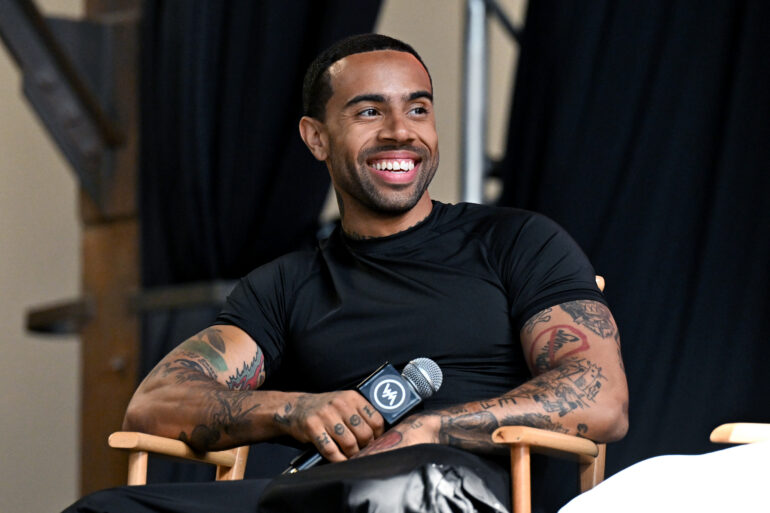
Chicago-born rapper, writer, actor, and activist Vic Mensa first gained national attention through his music, emerging alongside Chance the Rapper and a generation of boundary-pushing Chicago artists. Since then, his career has continued to expand across mediums, from music and film to essays, interviews, and public dialogue tackling timely cultural and political issues. From his viral orange tree videos on Instagram, to the New York Times opinion section, The Don Lemon Show, and a forthcoming SXSW appearance, Mensa continues to drive cultural conversations forward in powerful new ways.
I spoke with Mensa as he launched a new Chicago initiative connected to one of his more recent ventures: 93 Boyz, the cannabis company he founded and Illinois’ first Black-owned cannabis brand. Its newest effort, the 93 Boyz Free Smoke Medical Program, provides no-cost medicinal cannabis to adults experiencing medical, physical, or financial hardship through a partnership with Soul & Wellness. The program is part of a broader push by the brand to connect legalization with tangible community benefit.
View this post on Instagram
Investing in His Chicago Roots
The initiative reflects the wider mission behind 93 Boyz, which Mensa describes as an effort to redirect the benefits of legalization toward communities historically harmed by the criminalization of cannabis. Rather than positioning the brand primarily as a retail venture, he sees it as part of a broader effort focused on community reinvestment, education, and reducing stigma around responsible and medicinal use.
“I was inspired to start the company because my big brother was killed for a quarter pound of weed when I was 17. He was a joy — a light to the community,” Mensa said. “When I had the opportunity to step into the cannabis industry, I felt like I’ll be carrying on his legacy.”
The company, he added, also grew out of philanthropic work he had already been doing in Chicago, shaping an approach that blends entrepreneurship with community investment.
Launched during Black History Month, the Free Smoke Medical Program focuses on restoring attention to cannabis’ medicinal role while expanding access for communities disproportionately harmed by the war on drugs.
“Black people have been impacted cataclysmically by the war on drugs,” Mensa said. “So many people of all communities use the plant medicinally — from the mental to the physical to spiritual — and we wanted to bring the focus back to the medicinal properties of the plant and help people that need the medicine.”
For Mensa, the program is one expression of a broader philosophy about participation and responsibility — the same outlook that shapes how he approaches music, activism, and public conversation.
“We have agency, we have opportunity, we have the ability,” he said.
The Art of Communication
In recent months, Mensa has joined national conversations about politics and culture through a New York Times opinion essay examining immigration enforcement, a widely shared discussion with journalist Don Lemon about race, politics, and public dialogue, and by traveling to Minneapolis following the killings of Renée Good and Alex Pretti, joining community members on the ground as protests unfolded. He also regularly shares reflections through Instagram videos filmed beside an orange tree outside his home.
In the videos, Mensa plucks an orange from the tree and casually peels it while unpacking everything from race, religion, and personal growth to culture and national politics.
“It’s definitely an art form in and of itself,” he said of the posts. “It’s just the art of communication. It’s everything from the personal to the political to philosophical.”
He sees those reflections as connected to the same creative instincts that shape his music, writing, and filmmaking.
“It’s songwriting in a way, it’s comedy, and it’s cinema in a way,” he said. “It’s just authentic representation of me.”
At the same time, Mensa is careful not to frame political commentary as an obligation for artists.
“I don’t think it’s any artist’s responsibility to speak on things they may know nothing about.”
His own motivation, he said, is more personal.
“I’m most interested in unifying people, second only to my first primary objective, which is to express my humanity.”
Chicago as Education
Mensa traces much of his outlook back to Chicago, where he came of age alongside a generation of artists reshaping hip-hop.
“My dad always says he wanted me to be raised in Chicago so I would learn the truth about America,” he said.
The city, he explained, reflects many of the country’s contradictions.
“Chicago is a very blatant like microcosm for most of what America is… it’s very culturally influential… it’s also very wealthy, it’s also very poor, it’s also very segregated, it’s also very dangerous, and then it’s also very safe.”
He situates himself within a lineage alongside contemporaries including Chance the Rapper, Chief Keef, Lil Durk, Noname, and Saba, and cites earlier artists such as Kanye West, Lupe Fiasco, and Common.
“We were able to walk in the footsteps of some really brilliant artists, and have been able to make our own way too… I owe everything to Chicago for sure.”
Learning as Action
During our conversation and throughout his online dialogues, Mensa regularly reinforces learning as an ongoing responsibility, often recommending further reading, including Ibram X. Kendi’s How to Be an Antiracist.
“It takes humility to be genuinely concerned with the fate of others — those that you think are unlike you, that belong to a different race, a different religion, or different nations,” he said. “But ultimately, you’ll free yourself, because being hateful is a prison in and of itself.”
He also pointed toward emerging voices shaping culture through dialogue, recommending The Jam Podcast.
“They’re pop culture and hip hop… and they’re 21 years old — the kids are gonna be all right,” he said.
The comment also reflects how Mensa increasingly thinks about the next generation more broadly. Even as his reach beyond music expands, he continues releasing new work, including the recent video for “Still With the Smoke,” filmed in Senegal on an iPhone — an intentionally simple approach he often encourages younger artists to embrace by creating with the tools they already have.
That outlook has taken on new meaning as he steps into another role: fatherhood.
“It’s changing my life in a million ways… growing every day.”
More From Better:
- Tom Morello on Music, Activism and Bringing ‘Revolution(s)’ to Chicago’s Goodman Theatre
- 18 Black-Owned Restaurants in Chicago and the Suburbs to Support During Black History Month… and All Year Round
- Beyond Ukraine’s Front Lines: Portraits From the Civilian Relief Effort
Brooke McDonald is the editor in chief of Better Magazine. She regularly reports on entertainment, theme parks, and travel and her work has appeared in Insider, The Points Guy, Parents, TravelPulse, Scripps News, and more. Her favorite nonprofits to support include World Central Kitchen, the ACLU, Direct Relief, and the Vitalogy Foundation. Find her on Instagram @brookegmcdonald, Threads @brookegmcdonald, Bluesky, and X @BrookeGMcDonald.