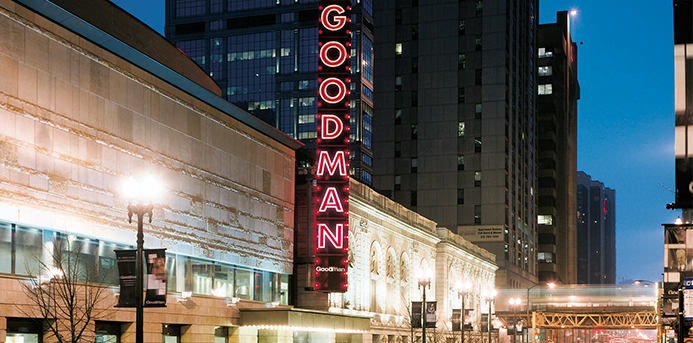
The Goodman Theatre in Chicago celebrates its 90th anniversary this season.
It is another milestone for the longest active nonprofit theater in Chicago, and its two stages will be filled with works by established playwrights and some promising comedies by bright new names.
Robert Falls, who has been the theater’s artistic director since 1986, reflects on his tenure, which has been a bridge between the old and new theatrical spaces.
“The key event in my lifetime at Goodman was moving the theater into the North Loop,” he says. “In collaboration with executive director Roche Schulfer, an extraordinary Board of Trustees, the city of Chicago and Mayor (Richard M.) Daley, we made this amazing building happen.”
Before 2000, the 90-year-old theatrical enterprise, which opened with its own school in 1924, presented shows in a below-ground facility designed by area architect Howard Van Doren Shaw at the north end of the Art Institute of Chicago on Columbus Drive. For more than a quarter of a century, it operated as an acting school, with students such as Karl Malden, Sam Wanamaker andGeraldine Page going through its doors.
It was home to significant productions, including the 1967 premiere of Tennessee Williams‘ “The Eccentricity of a Nightingale;” Lorraine Hansberry‘s “To Be Young, Gifted and Black” in 1974, the theater’s first mainstage play by an African-American writer; and the American premiere in 1983 ofDavid Mamet‘s “Glengarry Glen Ross,” which went to Broadway the next year and won Mamet the Pulitzer Prize for drama.
At the turn of the Millennium, Goodman moved to its present location on Dearborn Street between Lake and Randolph streets, a block formerly occupied by the then-shuttered Harris and Selwyn theaters. The landmarked exteriors were retained, but everything within was completely new, including the mainstage Albert Theatre with 856 seats and the 450-seat Owen Theatre.
With that move, Goodman became the lynch pin of the city’s theater district, which includes theChicago Theatre, Cadillac Palace and the Oriental, all former movie palaces, beautifully restored for live touring and national shows.
Highlights from the Goodman’s History
A theater, however, must be more than its impressive facilities, and Goodman continually shines. “Artistically, I’m particularly proud of a couple things, beginning with our long-term relationship withAugust Wilson,” Falls says. “Goodman was the first theater in the world to produce all 10 plays in the African-American playwright’s cycle, including two world premieres, ‘Gem of the Ocean’ and ‘Seven Guitars.'”
This season, Wilson will be the subject of a citywide celebration of the 70th anniversary of his birth and the 10th anniversary of his death. Various theaters will arrange readings of all Wilson’s plays in his 20th century cycle. Goodman will present his “Two Trains Running” from March 7 to April 13 in the Albert.
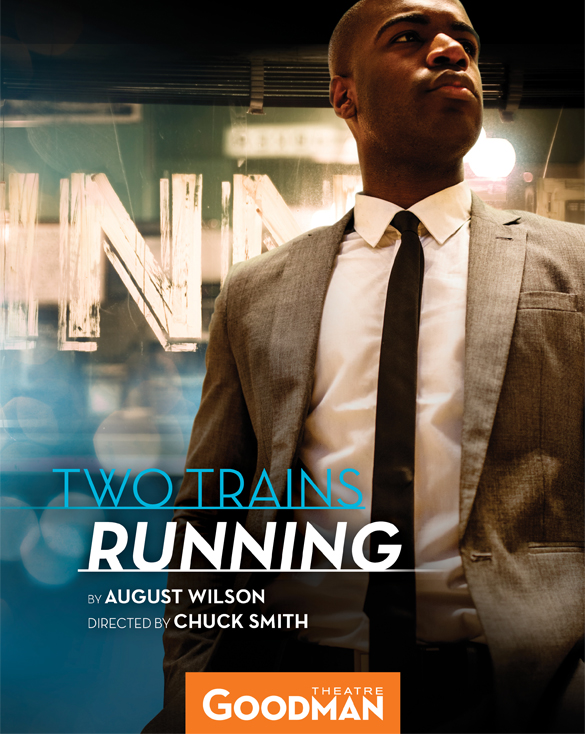
Poster design by Kelly Rickert.
Calling Eugene O’Neill a great American writer and his favorite American playwright, Falls adds, “I’m so proud that we were able to collaborate with international and Chicago companies to produce O’Neill’s work with my production of ‘Desire Under the Elms’ as the centerpiece. It was a world-class exploration and event.”
In the spirit of celebration, the new season reflects the direction the theater has taken during Falls’ 28 years at the helm. Priorities include new works by living playwrights, with an emphasis on diversity, plus plays by significant writers from the past. Goodman shows are selected by an artistic collective, which includes Brian Dennehy, Rebecca Gilman, Henry Godinez, Steve Scott, Chuck Smith, Regina Taylor, Henry Wishcamper, Mary Zimmerman and Falls.
Actors reflect on their work at the Goodman
By a pleasant coincidence, both Goodman Theatre and actor Mike Nussbaum are 90 years old. The veteran actor, who has been on Chicago area Equity stages for four decades, will star in the first mainstage production of the Goodman’s 90th season, “Smokefall,” a new work by Noah Haidle, which runs from September 20 to October 26.
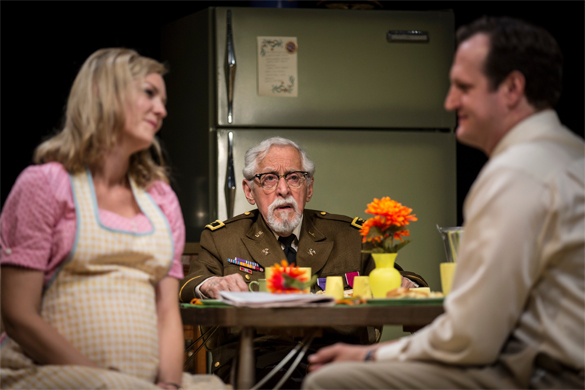
“Smokefall” by Liz Lauren.
“It’s a charming play,” Nussbaum says. The production is an encore—the family drama was staged by Goodman last fall in its Owen Theatre to critical acclaim. The original cast has been reassembled for its reprise in the Albert, which has nearly double the Owen’s capacity.
When asked how he can keep going strong at age 90, Nussbaum modestly ascribes it all to “pure genetics.” When he was raising his family in Highland Park and running an extermination business, Nussbaum performed in industrial shows, and always memorized his lines.
“I have the good luck to still be able to memorize my lines,” he says.
Finally, when all the children were grown, Nussbaum’s late wife Annette urged him to audition for professional roles, while she became the breadwinner. “I started at St. Nicholas Theatre whenGreg Mosher took over from [playwright] David Mamet. The first show was ‘American Buffalo’ withWilliam H. Macy. On opening night we were still hammering down the stage boards.”
His timing could not have been better. The Chicago theater scene was beginning to blossom, and Nussbaum became an essential part of it.
He has won two Joseph Jefferson Awards amid 13 nominations between 1972 to 2011, the year he won his second Jeff for Best Supporting Actor in “Broadway Bound” at Drury Lane Oakbrook. His first win was for Best Actor in 1997 for “Racing Demon” at the Organic Touchstone Company in Chicago. Plus, his very first nomination was for Best Supporting Actor in “The Royal Family” at—you guessed it—Goodman Theatre.
Nussbaum won a national Emmy nomination for his portrayal of Chief Justice Felix Frankfurter in the 1991 television movie “Separate But Equal.” And his list of Hollywood movies includes “Men in Black,” “Fatal Attraction” and “Field of Dreams.”
When told that whenever he came on screen in North Shore theaters, whispers of, “That’s Mike Nussbaum” could be heard, he laughs and replies, “I’ll give you one better. When I was playing an exterminator in a play at Northlight Theatre, I heard someone in the audience whisper, ‘He used to be my exterminator.'”
Regina Taylor is perhaps best known to the public as an actress who has appeared in film, television and the theater to considerable acclaim, including a Peabody Award for her portrayal of Anita Hill in the television movie “Strange Justice,” plus NAACP Image Awards and two Emmy nominations for her work in television dramas. But it was as a playwright and director that she became an artistic associate at Goodman and a member of its artistic collective.

Regina Taylor with Michelle Obama. Photo by Paul Berg.
“Goodman saw my work at the 1993 Humana Festival and almost every year since I’ve had a play there,” she says, mentioning “The Ties that Bind,” “Watermelon Rinds” and “Escape from Paradise” produced in Goodman Studio. Her mainstage plays include two productions of her buoyant musical “Crowns” in the 2003-04 season and the 2011-12 season.
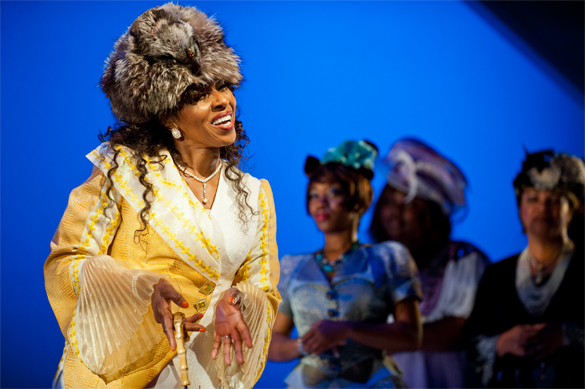
“Crowns” by Liz Lauren.
“It has been a fortuitous connection,” she says.
She also has directed a number of her mainstage shows at the Goodman. “Goodman really challenges its audiences, and Chicago audiences are very open for adventure,” she says.
One of the last plays of Goodman’s anniversary season is Taylor’s “stop. reset.,” which runs May 23 to June 21 of next year. “It’s set in Chicago and tells the story of an African-American book publisher who is over 60 and has to deal with this new technological age,” Taylor says. “It’s about economic, social issues and philosophy.”
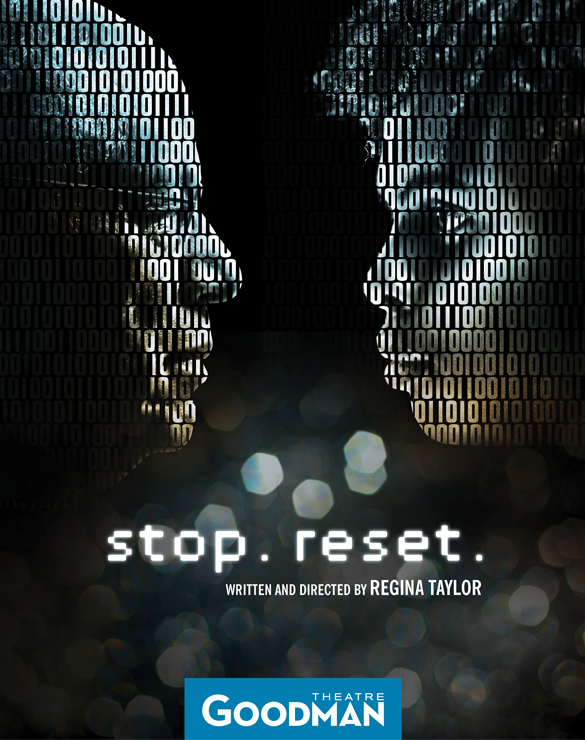
Poster design by Kelly Rickert.
In reflecting on the laurels that have been given to Goodman, Falls says with obvious pride, “We won the distinguished Tony Award for Outstanding Regional Theatre in 1992, and in 2003, TIME magazine named us ‘Best Theatre in America,’ which was a one-two punch of recognition.” Other Chicago theaters have also won that award, including Steppenwolf in 1985, Victory Gardens in 2001, Chicago Shakespeare Theater in 2008 and Lookingglass Theatre Company in 2011. In fact, Chicago has more regional Tony awards than any other city in the country, which Falls regards “as a tribute to the vitality of Chicago theater.”
“If I have to pick a signature production of mine, it would be 1999’s ‘Death of a Salesman’ starring Brian Dennehy,” Falls says. “It won several Tonys, including Best Revival of a Play, Best Actor in Play for Brian, Best Featured Actress in a Play for Elizabeth Franz, and I won for Best Direction of a Play. It subsequently appeared in London’s West End, which enhanced our national reputation, both for the Goodman and for me personally.”
This season at Goodman
Check out the shows running at Goodman during its 2014-15 season:
- World of Extreme Happiness
- Smokefall
- A Christmas Carol
- Rapture, Blister, Burn
- Two Trains Running
- The Upstairs Concierge
- The Little Foxes
- stop.reset.
- Vanya and Sonia and Masha Spike
No matter how high-powered the play or the playwright, Goodman’s best-loved show surely is “A Christmas Carol,” its annual holiday gift to Chicagoans. This is the play’s 37th season. It runs from November 15 to December 27 in the Albert and it doesn’t need an anniversary to make it a must-see. In addition, in a first-ever collaboration with Goodman, the Second City is doing a holiday send-up titled “Twist Your Dickens” from December 5 to 28 in the Owen.
Goodman Theatre hosts its 90th Anniversary Celebration at 6 p.m. Monday, Oct. 20 at the Standard Club, 320 S. Plymouth Court, Chicago. Distinguished guests include Carla Gugino, Cherry Jones and Brian Dennehy. Sondra A. Healy chairs the event and honorees are James E. Annable, Past Chariman and Life Trustee, and Albert Ivar Goodman, Honorary Chairman and Life Trustee. Tickets start at $500. Contact Goodman90@goodmantheatre.org or call 312.443.3811 ext. 586.
Top right photo by Jeff Goldberg.