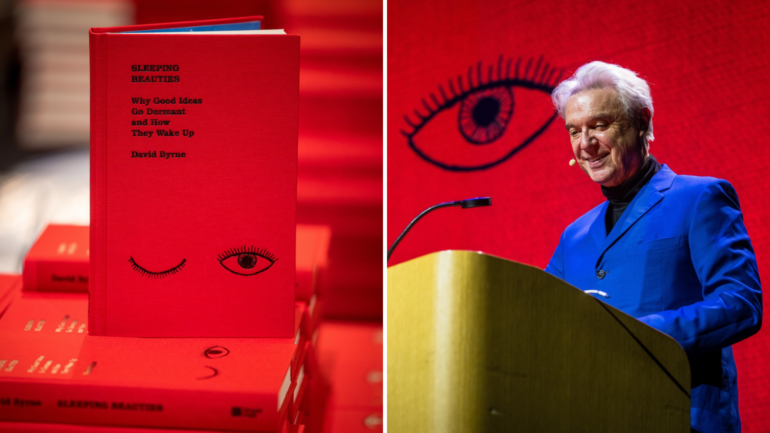
David Byrne has worn some memorable suits onstage, most famously the oversized gray suit in Talking Heads’ concert film Stop Making Sense. But at Chicago’s Athenaeum Center for Thought and Culture on Oct. 15, there was no giant suit, no band, and no choreography. In a simple blue suit and turtleneck, speaking to a packed house for Chicago Humanities, Byrne looked more like a thoughtful college professor than a rock star. An innovator in nearly every medium he’s touched, he spent the evening talking about other people’s breakthroughs, and why history overlooked them.
The occasion was Byrne’s new book, Sleeping Beauties: Why Good Ideas Go Dormant and How They Wake Up, published on Oct. 6.
For fans familiar with his work beyond music, this was hardly a departure. The musician, artist, and writer has spent decades following his curiosity into subjects far removed from the recording studio. His excellent 2012 book How Music Works examines how architecture, technology, economics, and culture shape the music we make and hear.
And in Theater of the Mind, his immersive production co-created with Mala Gaonkar and presented by Goodman Theatre, a 2026 Make It Better Foundation Philanthropy Award winner, he uses neuroscience and sensory experiments to challenge our perceptions of reality.
When I interviewed Byrne about that production earlier this year, he told me, “I’m kind of fascinated by how we construct reality. How much of it is actually out there, and how much of it is what we bring to it?”
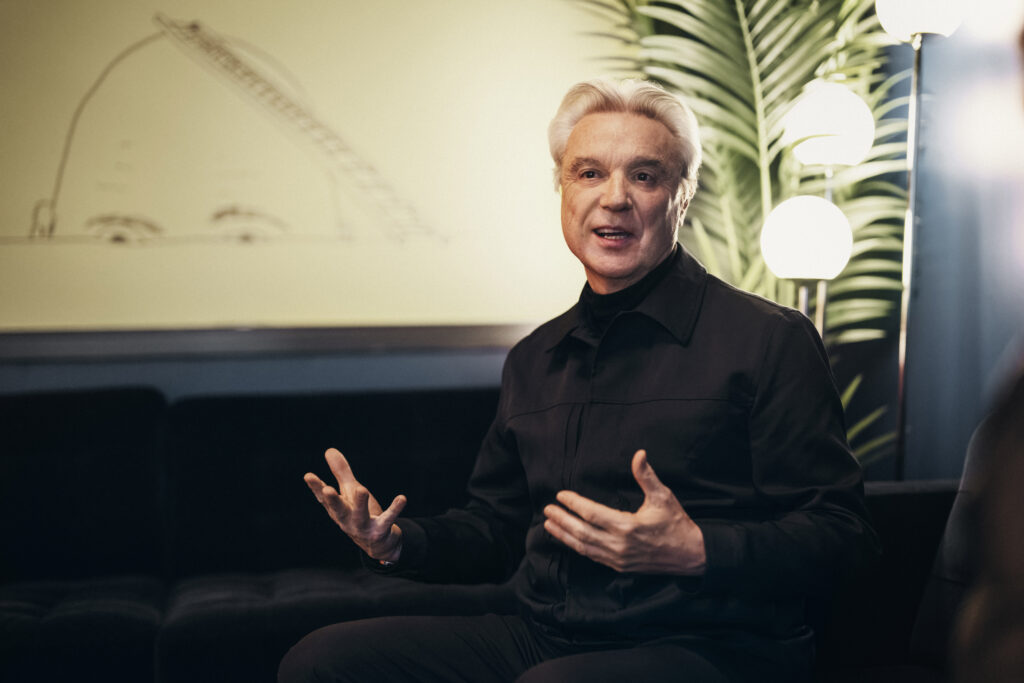
Sleeping Beauties approaches a related question from a different direction: What if some of the things we accept as progress have caused us to overlook ideas that were better all along?
Byrne borrowed the term “sleeping beauties” from science, where it describes research that goes unnoticed for years before being rediscovered. He applies it more broadly, to ideas, inventions, and works of art that had their moment, or at least a hearing, then faded from view, only to be rediscovered years, decades, or even centuries later.
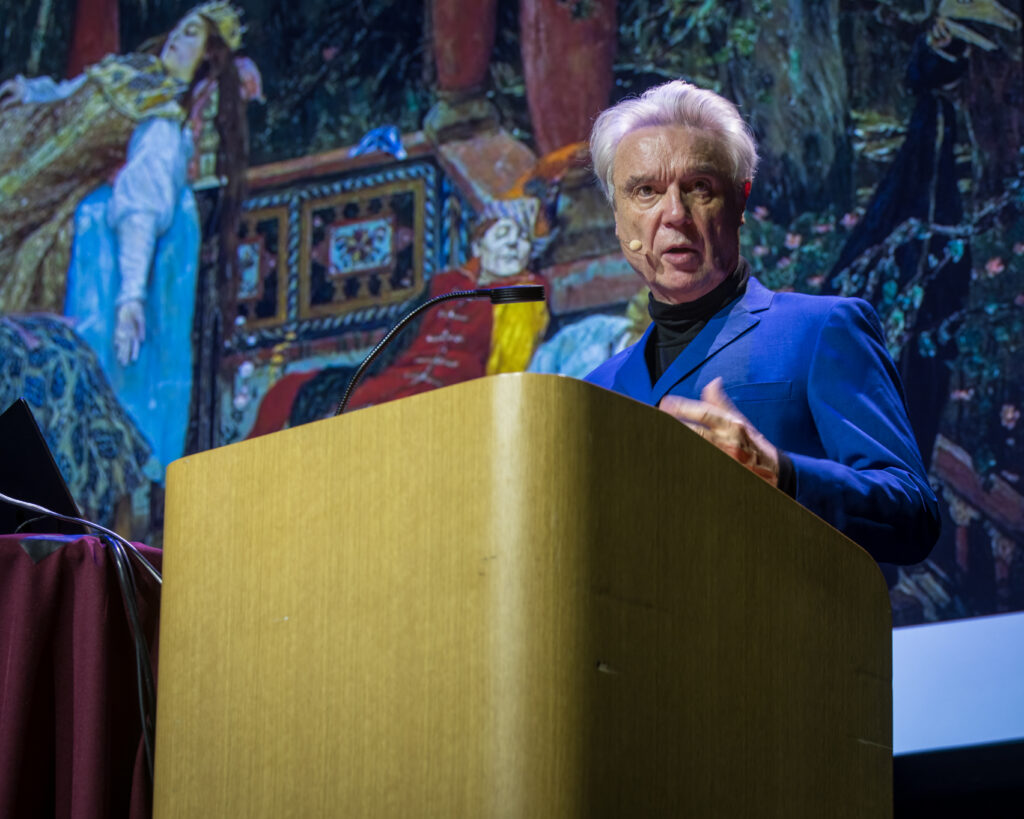
At the Athenaeum, Byrne illustrated the concept with three stories from the book: ancient Roman concrete, Renaissance painter Sandro Botticelli, and evolutionary biologist Lynn Margulis. He then added two that didn’t make it into the book: the number zero, and the surprisingly complicated history of scientific understanding of female anatomy.
Funny, sometimes sobering, and full of surprising connections to the present, the talk played like an abridged version of the book, with a couple of bonus tracks. For the full version, I recommend the audiobook, which Byrne narrates. Here are five takeaways that stayed with me.
1. It’s never too late to question what we think we know.
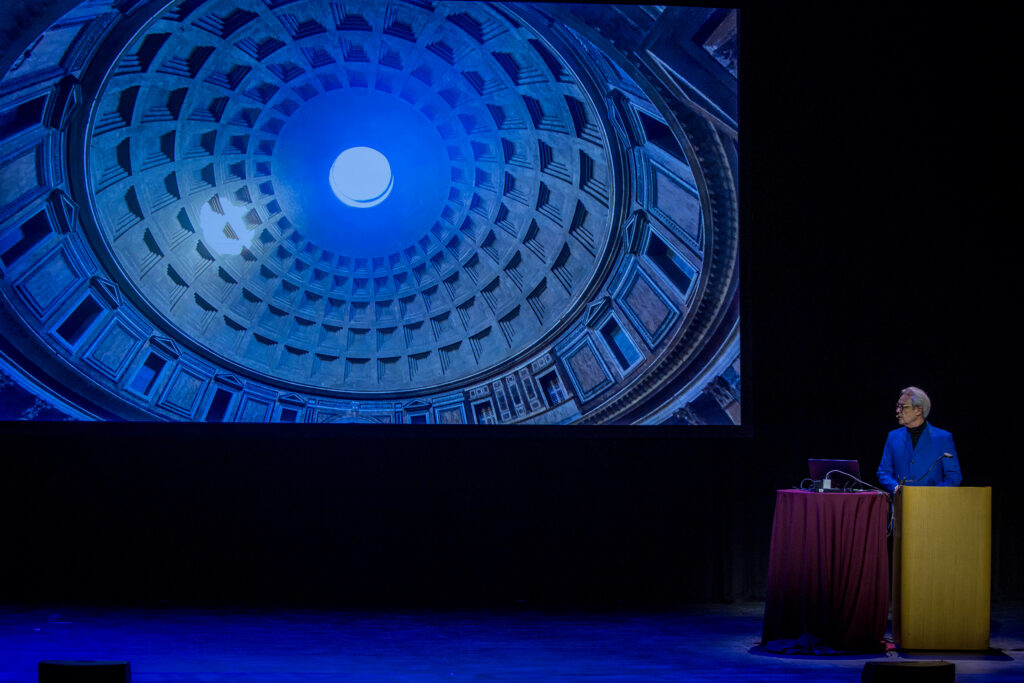
The Romans built structures that have survived for nearly 2,000 years, including the Pantheon, whose massive concrete dome, completed around A.D. 126, remains standing today. Modern concrete is another story. Byrne showed a parking garage built with concrete expected to last about 50 years, or 100 if you’re lucky. That, he said, is the best we can expect.
As Byrne explained, scientists studying ancient Roman concrete had long dismissed tiny white particles in the material, called lime clasts, as evidence of poor mixing. But in 2023, an MIT team led by materials engineer Admir Masic found that those particles were part of what made the concrete so durable. When water seeps into a crack, the lime dissolves and refills it, allowing the concrete to effectively heal itself.
The Roman recipe isn’t just more durable. It’s also cheaper and cleaner to make, a big deal when cement production accounts for about 8 percent of global carbon emissions. Researchers are now working to bring it back. For Byrne, that’s the larger lesson: things we think we already understand may still have something to teach us.
2. Newer doesn’t always mean better.
The story of Roman concrete also raises a larger question: Why did we abandon something that worked so well?
As Byrne demonstrated, the answer isn’t always that a superior innovation came along. Political priorities, economic incentives, cultural trends, and powerful industries can all determine which technologies succeed and which disappear.
Roman concrete depended on costly, state-funded building projects, and as the empire overextended itself, those projects dwindled. After Rome fell, the technique fell out of use. When concrete made its comeback more than 1,300 years later, it was a different, less durable material: Portland cement, patented in England in 1824.
Modern concrete became a global symbol of progress. Drawing on the work of Vyta Pivo, an architectural historian at the University of Miami School of Architecture, Byrne described a worldwide industry campaign promoting the material in places as different as India, Australia, Japan, and the United States. Byrne quoted Pivo, who grew up in Lithuania, recalling that a concrete apartment tower meant modern kitchens and bathrooms. It meant living in the future. Yet the material came with shortcomings that have left us with deteriorating infrastructure and enormous environmental costs.
Byrne challenged the assumption that human knowledge advances in a straight line, with each generation inevitably improving on the last. “We like to imagine ourselves as some sort of inevitable culmination — it all led to us,” he writes in the book.
But sometimes a new technology offers a cheaper or more convenient solution without being a better one in the long run. Which means progress might actually be rediscovering what we’ve lost.
3. Great ideas don’t always come from the experts.
Expertise is valuable, but it can also create blind spots.
Byrne pointed to Lynn Margulis, whose 1967 theory that complex cells evolved through symbiotic relationships between simpler organisms was initially rejected by the scientific establishment. By his count, 15 journals turned the paper down. She wasn’t the first to propose the idea, either. Versions of it dated back to 1890, and each time it was ridiculed or ignored.
Margulis was born in Chicago in 1938 and enrolled in the Lab School at the University of Chicago at 15. Her ideas challenged prevailing assumptions about evolution and required thinking across disciplines that rarely communicated with one another. Margulis recalled that at Berkeley, the paleontologists who studied evolution and the geneticists had almost nothing to do with each other. Eventually, advances in DNA analysis helped confirm her theory, and Margulis received the National Medal of Science in 1999.
Specialists, Byrne argued, can become so focused on their own fields that they overlook connections visible to someone approaching a problem from a different perspective.
It’s an encouraging thought for anyone who’s ever been hesitant to speak up amongst company they perceive to be more knowledgeable on a subject. Sometimes the most valuable question comes from an outsider who doesn’t realize the experts consider the case closed.
4. Sometimes the biggest obstacles to progress are people in power.
Not every forgotten discovery disappears because people lose interest. Some are suppressed, dismissed, or discredited because they challenge established beliefs or threaten powerful institutions.
Byrne described how Botticelli, celebrated in his lifetime, fell out of favor as religious fundamentalism took hold in Renaissance Florence. The Dominican friar Girolamo Savonarola condemned paintings of pagan subjects, and mythological works like Botticelli’s became unacceptable. Botticelli died in poverty in 1510 and was largely forgotten for centuries.
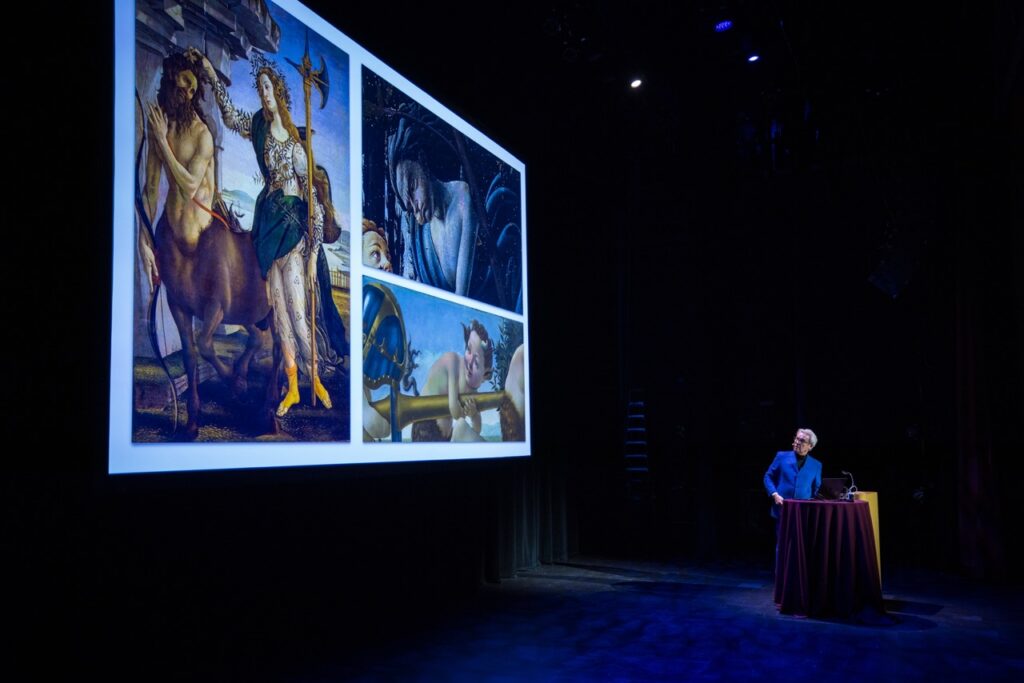
It took the Romantics, Grand Tour travelers, and the Pre-Raphaelites to revive his reputation in the 19th century. Byrne noted that one of Botticelli’s late religious works, the Mystic Nativity, once sold to an English collector for £80. In 2021, his Young Man Holding a Roundel sold for more than $92 million.
“It’s the same work. It hasn’t changed,” Byrne said. “It’s us who have changed.”
Byrne is skeptical of the usual explanation for artists like this. “‘Ahead of their time’ is a cliché,” he writes in the book. “Rather than being ahead of their time, I’d prefer to think that these folks saw their times more clearly and astutely than most of the others around them.”
The two stories that aren’t in the book make the same point. The number zero, developed in India and carried to Europe through Arabic scholarship, struck many medieval Christians as suspect: How could a number represent nothing? In 1299, a Florentine statute barred Arabic numerals from commercial records, but merchants, the Medici among them, adopted them anyway. Doctrine didn’t stand a chance against easier bookkeeping.
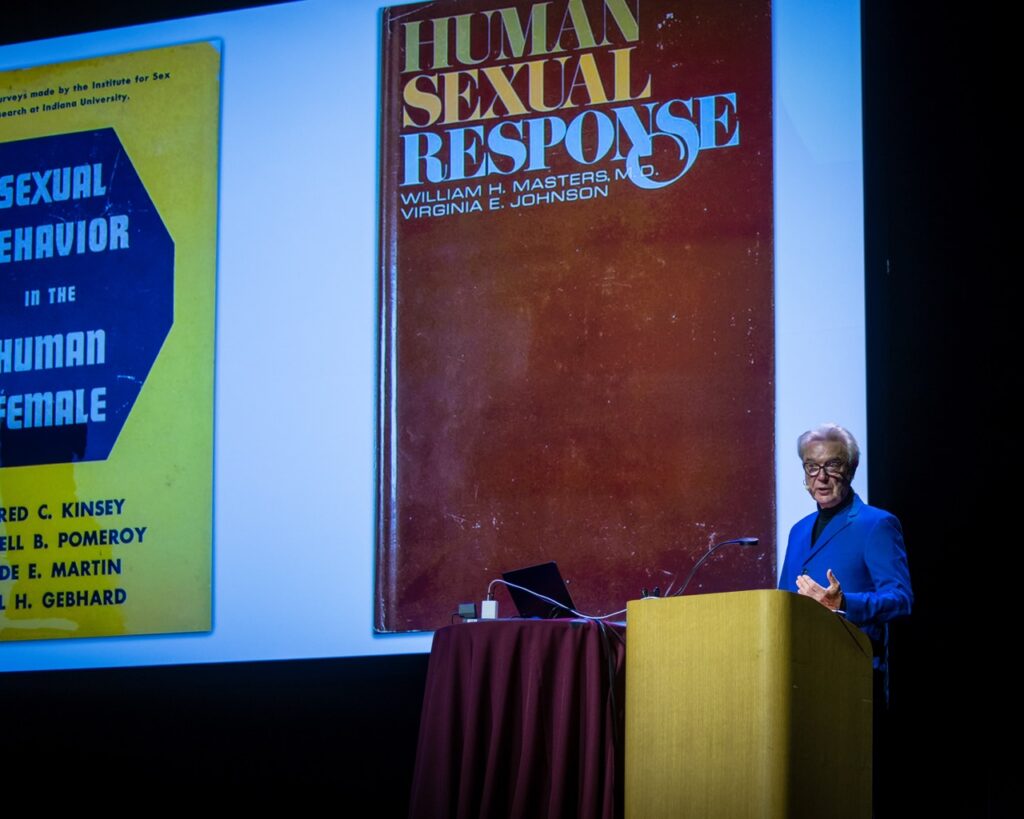
Byrne saved the clitoris for last. Greek physicians described it, and Roman, Indian, and Arab writers understood exactly what it was for, yet European anatomists kept dismissing it or forgetting it altogether. Gray’s Anatomy included it in 1901 and had quietly dropped it by 1948. It wasn’t until 1998 that Australian urologist Helen O’Connell published the first comprehensive anatomical study of the organ, showing it was far larger and more complex than textbooks had let on. And the first full map of its nerves didn’t arrive until this spring, nearly 30 years after scientists did the same for the penis. The cheers that followed carried an unmistakable message: Finally.
Good ideas don’t always win on their own, Byrne reminded us. Sexism, racism, religious dogma, and plain old institutional foot-dragging can put them to sleep for centuries.
5. Curiosity and cooperation can change everything.
For all the stories of lost knowledge and missed opportunities, Byrne’s message was ultimately optimistic.
He said he first organized the book around why ideas were forgotten, then realized the culprits were the usual suspects. So he turned instead to how they were rediscovered, in hopes of learning how to find the ones still out there.
He emphasized the importance of collaboration across disciplines and the possibility that answers to some of today’s problems may already exist somewhere we haven’t thought to look.
Margulis’ research offered a particularly compelling example. Her work demonstrated that cooperation between organisms helped make complex life possible, challenging the idea that competition alone drives evolution.
And it’s an idea that seems especially relevant to Byrne himself, whose career has moved freely among music, theater, visual art, science, and writing.

Some of the most fascinating examples in Sleeping Beauties are tied to music, a subject he examined from seemingly every angle in How Music Works. But his interests have never been confined to the field that made him famous. The book ranges from Bach, Vermeer, and Kafka to solar panels and continental drift.
When we spoke earlier this year about Theater of the Mind, Byrne made an observation that seems equally relevant to Sleeping Beauties: “We’re not stuck in who we are, in our identities and how we see the world. All those things can change and evolve.”
Byrne doesn’t claim to know which overlooked ideas are waiting to be rediscovered next. But he believes they’re out there, and that finding them doesn’t necessarily require specialized expertise.
In the fairy tale, Sleeping Beauty is awakened by a prince. Byrne closed his Chicago Humanities talk with the suggestion that any of us could be the prince or princess who brings a forgotten idea back to life.
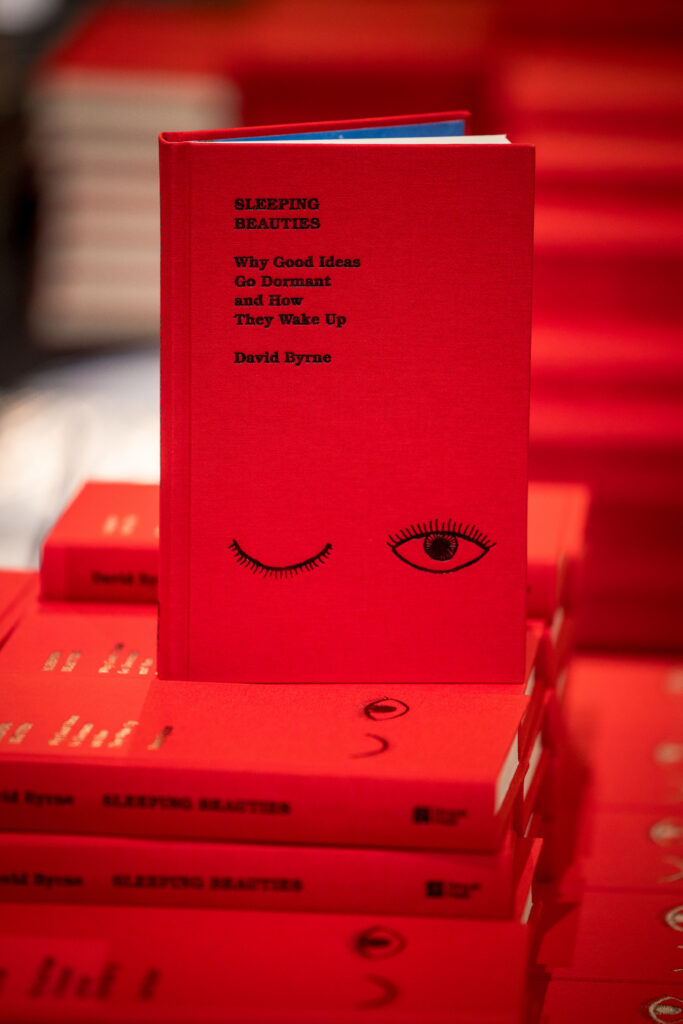
Sleeping Beauties: Why Good Ideas Go Dormant and How They Wake Up by David Byrne (Penguin Press) is available now. Theater of the Mind runs through Dec. 20, 2026. Tickets are available at TheaterOfTheMindChicago.com or through the Goodman Theatre Box Office. The Chicago Humanities Fall season continues Saturday, Nov. 7, with a festival day at the University of Chicago.
How to Help
Support Chicago Humanities, which presented Byrne’s talk, by attending a program, becoming a member, making a donation, or volunteering at its events. The Athenaeum Center for Thought and Culture, the Lakeview nonprofit that hosted the evening in its historic 1911 theater, welcomes support through ticket purchases and donations. You can also support Goodman Theatre, which brought Byrne’s Theater of the Mind to Chicago, by purchasing tickets or making a donation. To learn more about Byrne’s own philanthropic work, visit the Arbutus Foundation, which supports projects including Theater of the Mind and Reasons to Be Cheerful.
More from Better:
- David Byrne’s ‘Theater of the Mind’ Turns Neuroscience Into an Immersive Experience
- Tom Morello on Music, Activism and Bringing ‘Revolution(s)’ to Chicago’s Goodman Theatre
- 5 Lessons From Paul Nicklen’s New Book ‘A Photography Masterclass’ — On Creativity, Conservation, and Storytelling That Drives Change
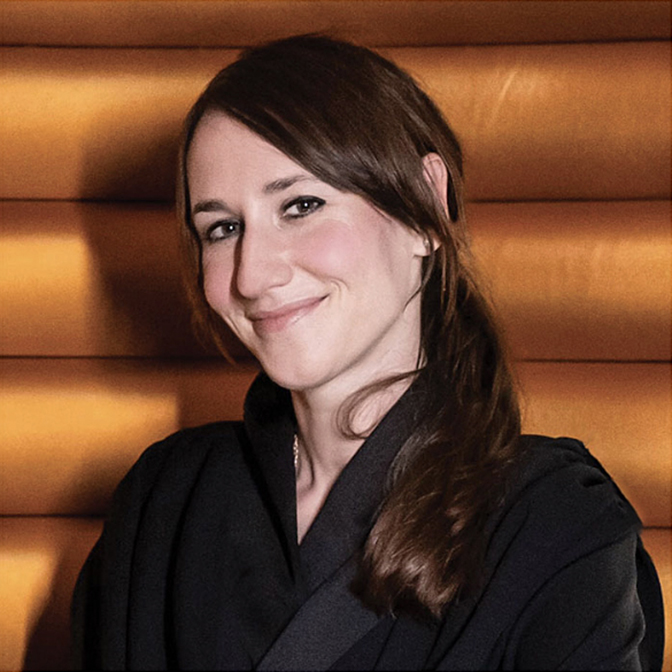
Brooke McDonald is the editor in chief of the Make It Better Foundation and its publishing arm, Better Magazine. She regularly reports on arts and culture, from music and books to travel and theme parks. Her work has appeared in Insider, The Points Guy, Parents, TravelPulse, Scripps News, and more. Her favorite nonprofits to support include World Central Kitchen, the ACLU, Direct Relief, and the Vitalogy Foundation. Find her on Instagram @brookegmcdonald, Threads @brookegmcdonald, Bluesky, and X @BrookeGMcDonald.