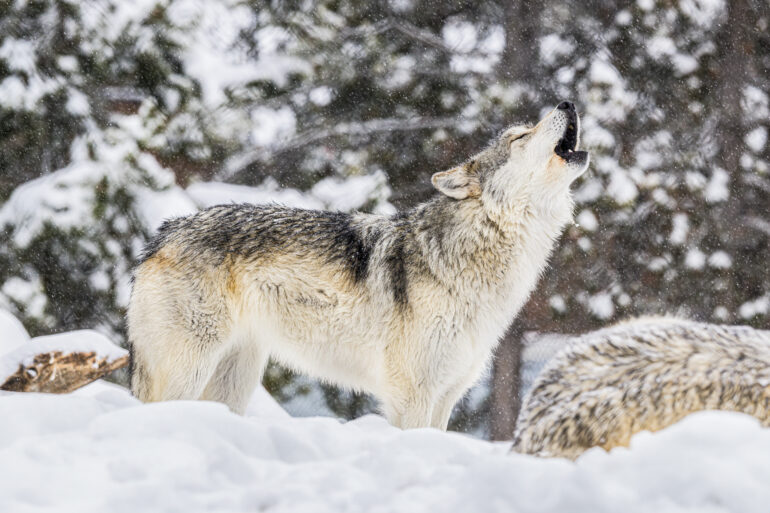
Just before dawn in Yellowstone National Park, something ancient fills the valley. A wolf howl rises — low, long, carrying for miles through the cold air. To most visitors, it is breathtaking. To Taylor Rabe and Amir Dehbi, Conservation Nation fellows working at the frontier of wildlife science, it is data.
Wolves are among the most ecologically important, and socially controversial animals in North America. As apex predators and a keystone species, their presence regulates entire ecosystems. When wolves were eliminated from Yellowstone in the early 20th century, elk populations surged unchecked, riverbanks eroded, willows disappeared, beavers vanished, and songbird numbers crashed. Their reintroduction in 1995 set off a cascade of recovery that researchers are still documenting today.
But wolves are not without controversy. Taylor Rabe, who works as a biological science technician with the Yellowstone Wolf Project, sees this tension firsthand — tracking radio-collared wolves, collecting samples at kill sites, and talking to visitors with very different feelings about whether wolves belong here at all.
“Yes, wolves are important to the ecosystem. But they are also really difficult to live with. Coexisting with predators is hard, especially when people’s livelihoods are on the line. There’s a reason wolves are controversial — but that’s exactly why it’s important to talk about them.” — Taylor Rabe, Conservation Nation Fellow
For ranchers across the West, wolves kill livestock and threaten multigenerational livelihoods. Both things can be true at once — and it’s precisely because coexistence is so difficult that the science of understanding wolves matters as much as it does.
The Science of the Howl
This is where Conservation Nation fellow Amir Dehbi comes in and where a field called bioacoustics is changing everything. Bioacoustics is the study of how animals produce, transmit, and receive sound. For wolves, it means scientists can now listen to, record, and analyze vocalizations at a scale that was simply impossible before. Never before has it been possible to document the full array of wild wolf sounds let alone begin to interpret what they might mean.
Dehbi, a PhD student in Environmental Studies at the University of Colorado Boulder, is applying machine learning to one of the most ambitious wildlife acoustics projects ever undertaken. Working with the Cry Wolf Project, researchers have built a database of over 200,000 hours of wild wolf vocalizations, the largest in the world. Across Yellowstone’s northern range, 48 autonomous recording units run continuously, capturing the full acoustic vocabulary of wolf social life: howls, growls, whines, barks. AI classifiers then sort and analyze those sounds with over 92 percent accuracy, identifying individual wolves by their unique howls without a single trap or collar.
One of the most powerful tools in this work is the spectrogram — a visual map of sound that plots frequency against time, turning a wolf howl into something researchers can see as well as hear. Spectrograms allow scientists to distinguish one wolf’s howl from another the way a fingerprint distinguishes one person from the next. Paired with direct field observation, they let researchers cross-reference what a wolf vocalizes with what it is actually doing in that moment building, over time, a picture of what different sounds actually mean.
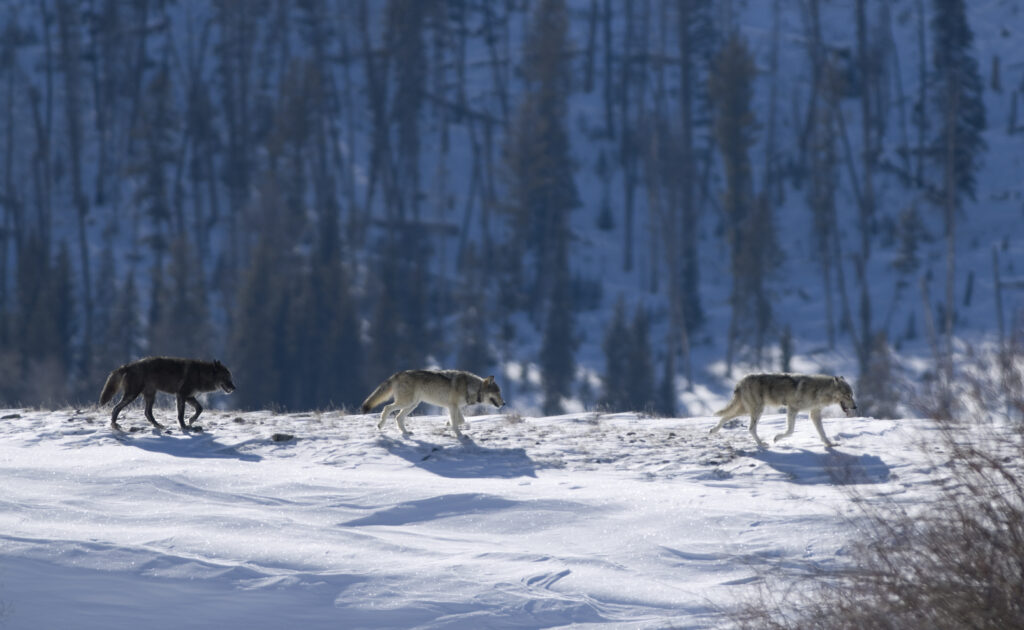
Paired with the decades of behavioral fieldwork the data is beginning to reveal something remarkable. In the heart of Yellowstone, wolves are howling, growling, whining, barking, and communicating in ways we are only beginning to understand. Territorial warnings. Bonding choruses. Rally calls before a hunt. Perhaps even something that resembles mourning. The wolf vocabulary, it turns out, may be far richer and more nuanced than science ever imagined.
“Can we explain that these are empathetic, emotionally complex animals that aren’t mindless hunters — and that they deserve the ability to coexist with us?” — Matt James, Chief Animal Officer, Colossal Biosciences
That question — what are wolves really saying? — is one humans have wondered about for centuries. Bioacoustics may finally give us the tools to answer it. And in doing so, it may do something even more important: change not just what we know about wolves, but how people feel about them. That shift could be the missing piece that makes lasting coexistence possible.
How to Help
Conservation Nation funds emerging wildlife scientists tackling the planet’s most urgent conservation challenges. Their fellows, including Taylor Rabe and Amir Dehbi, are working on the ground in places like Yellowstone to build the science, and the relationships, that make coexistence between humans and predators possible.
Interested in inspiring children from underserved communities to see themselves as wildlife champions? Please donate to bring the Academy into more schools and get more children out for a once in a lifetime trip to YNP.
Check out some of our free NGSS-aligned lessons, including:
🐺 Sound Science: Basics of Bioacoustics — Students explore how scientists study nature through sound with a hands-on Sound Map activity. Newly released.
🐺 Think Like a Wolf — Bring Yellowstone into your classroom. Students model a trophic cascade and analyze wolf communication and pack roles.
🐺 Listening to Wolves — A new lesson on wolf communication and what bioacoustics reveals about pack life. Coming soon.
Learn more and support the next generation of conservation scientists at conservationnation.org.

About the Fellows
Taylor Rabe is Conservation Nation’s inaugural fellow, currently serving as a biological science technician with the Yellowstone Wolf Project.
Amir Dehbi is Conservation Nation’s Applied AI Research Fellow and a PhD student in Environmental Studies at the University of Colorado Boulder, where he applies machine learning to wolf bioacoustics and population monitoring.