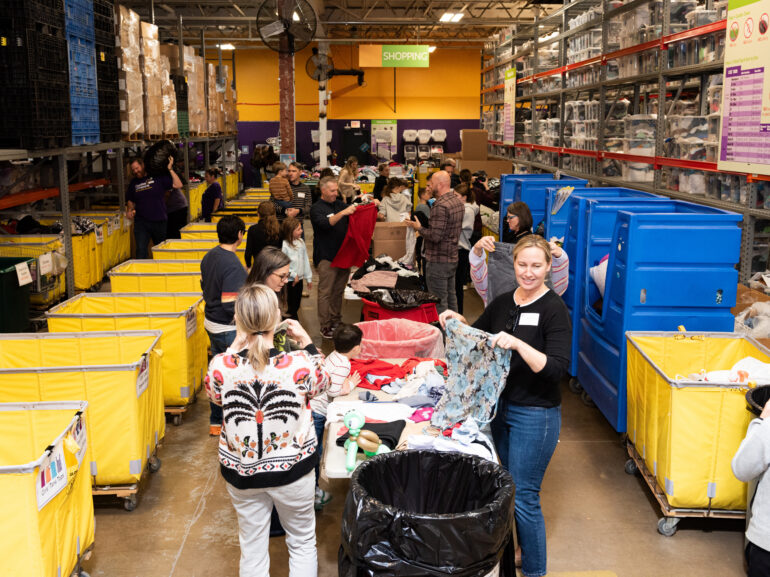
In the warehouse of Cradles to Crayons’ Giving Factory, bins upon bins are packed with bundles of clothing, from onesies to adult shoes.
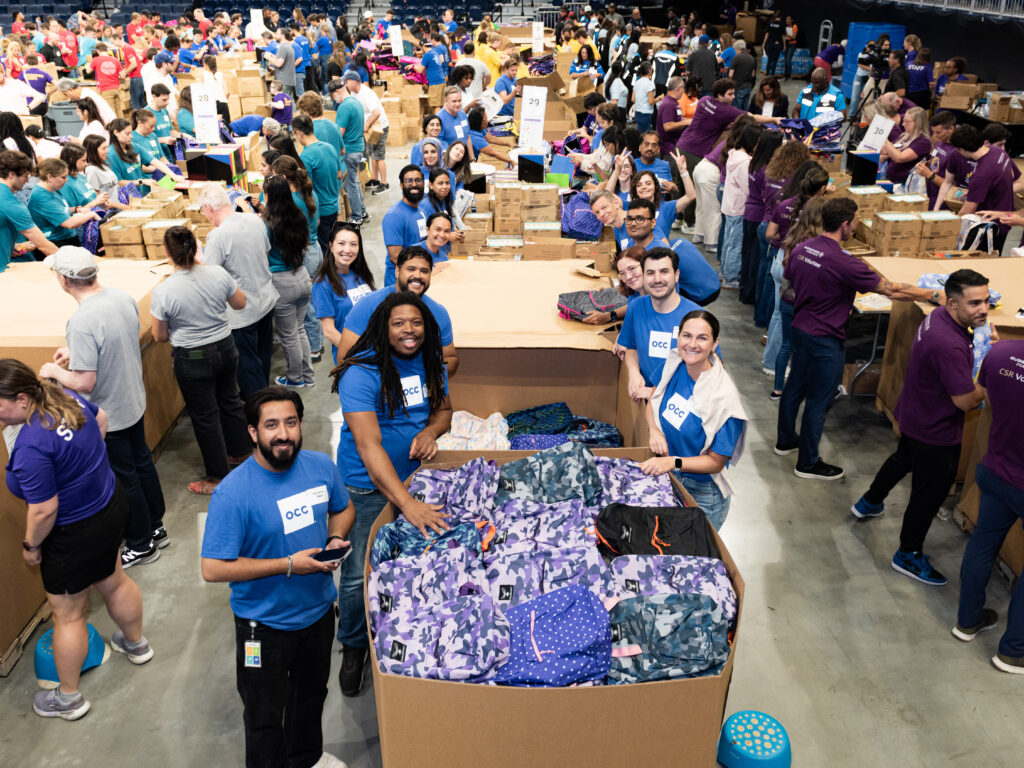
Throughout the year, Cradles to Crayons collects and distributes clothing, hygiene products, diapers, and shoes. They also collect seasonal items, such as winter coats and gloves, as well as educational and school items, like backpacks. Before the fall of 2026, the group plans to distribute 80,000 backpacks.
Getting the most out of a garment doesn’t end when you’re finished wearing it. Organizations like Cradles to Crayons help extend the life of clothing by putting quality items directly into the hands of children who need them, while ensuring items that are too worn to be passed along are responsibly recycled instead of discarded. That commitment to making the most of every donation not only helps families experiencing clothing insecurity, but also keeps thousands of pounds of textiles out of landfills each year.
For Julia Giordano, Senior Manager of Development for Cradles to Crayons, putting every item to use is part of being a good steward of donations. “If people trust us with their items, we want to do the best we can,” Giordano says.
Photo courtesy of Cradles to Crayons
The Environmental Impact of Fast Fashion
Back-to-school shopping and end-of-summer closet cleanouts offer an opportunity to think not only about where unwanted clothing goes, but also about the choices made when replacing it. Those decisions matter well beyond a single family’s closet.
The good news is that extending the life of clothing doesn’t require a complete wardrobe overhaul. Every stage of a garment’s life, from purchase to reuse, donation, and recycling, offers an opportunity to reduce waste while helping more clothing stay in use.
Shop Smarter
Making clothing last longer starts before it enters the closet. Consumers can consider quality, durability, and potential for reuse when making purchases, while fashion brands are increasingly designing garments to be repaired, resold, recycled, or made from lower-impact materials.
Brands like Patagonia, Lululemon, Eileen Fisher, Madewell, and Levi’s offer recycling programs that allow consumers to trade in used items for store credit and resell gently worn items through their own resale sites.
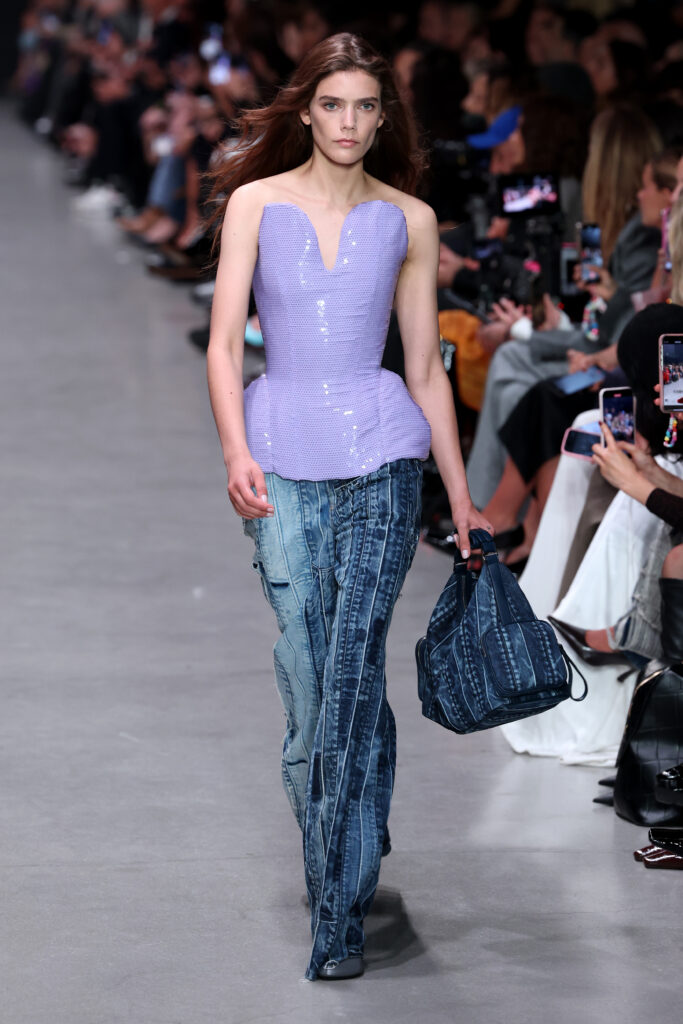
Few designers have pushed the fashion industry further toward circularity than Stella McCartney. Long before sustainability became mainstream, McCartney built her brand around reducing waste and advancing next-generation materials. She has partnered with The RealReal to extend the life of garments through resale, collaborated with textile innovator Evrnu to transform discarded clothing into new fibers, pioneered biodegradable denim made with plant-based materials, and most recently introduced denim featuring pollution-fighting PURE.TECH technology that helps capture carbon dioxide and other air pollutants. Her Summer 2026 collection also incorporated discarded denim and textile waste into new designs.
Stella McCartney Womenswear Spring/Summer 2026 show during Paris Fashion Week (Photo by Pascal Le Segretain/Getty Images)
The Ellen MacArthur Foundation, a charity geared toward eliminating waste and pollution by circulating products and materials, had an initiative from 2019 to 2023 called The Jeans Redesign, where they worked with leading brands to change how jeans were manufactured; 87 percent of post-consumer recycled content was incorporated into participant jeans. They worked with brands including Good American, JCPenney, Ralph Lauren and Wrangler.
Give Clothing a Longer Life
According to Cradles to Crayons, reusing one single garment can save 3 kilograms of carbon dioxide emissions, and extending the lifespan of clothing by just three months can reduce its environmental footprint by 5 to 10 percent.
That extra life might come from repairing a favorite piece, shopping secondhand, or donating pieces that no longer fit your style. Every additional wear helps reduce demand for newly manufactured clothing while getting more value from the resources already invested in making each garment.
Donate for Maximum Impact
When clothing is still in good condition, donating it to organizations that distribute it directly to families can multiply its impact. Those donations not only extend the life of clothing and other essential items, but also help address clothing insecurity for children across the country.
According to Cradles to Crayons, 1 in 3 children in the U.S. experience clothing insecurity; 82 percent of families they serve earn less than $30,000 per year.
“We really just believe that every child deserves high-quality items they can be proud of,” Giordano says. “Our work is to help remove those roadblocks, those inequities.”
Cradles to Crayons Backpack-a-Thon
Nationally, the organization distributed 2,466,237 items in the last fiscal year to families in Chicago, Philadelphia, Massachusetts, New York City and San Francisco. A new shirt is more than a new shirt. Clean, new-to-you clothing can help boost children’s confidence in school, or help kids participate in things like gym class or sports events. “A kindergartener can’t focus in school if their pants don’t fit,” Giordano says.
Recycle What Can’t Be Worn
According to Cradles to Crayons, every year Americans discard more than 17 million pounds of textiles, and two-thirds end up in landfills, even though many are still wearable. But what happens to the clothes that truly are too worn to be passed along?
Cradles to Crayons has quality, size, and item guidelines to ensure every child receives clothing they can feel good about wearing. “We don’t want kids to feel like they’re getting somebody’s ratty leftovers,” Giordano says.
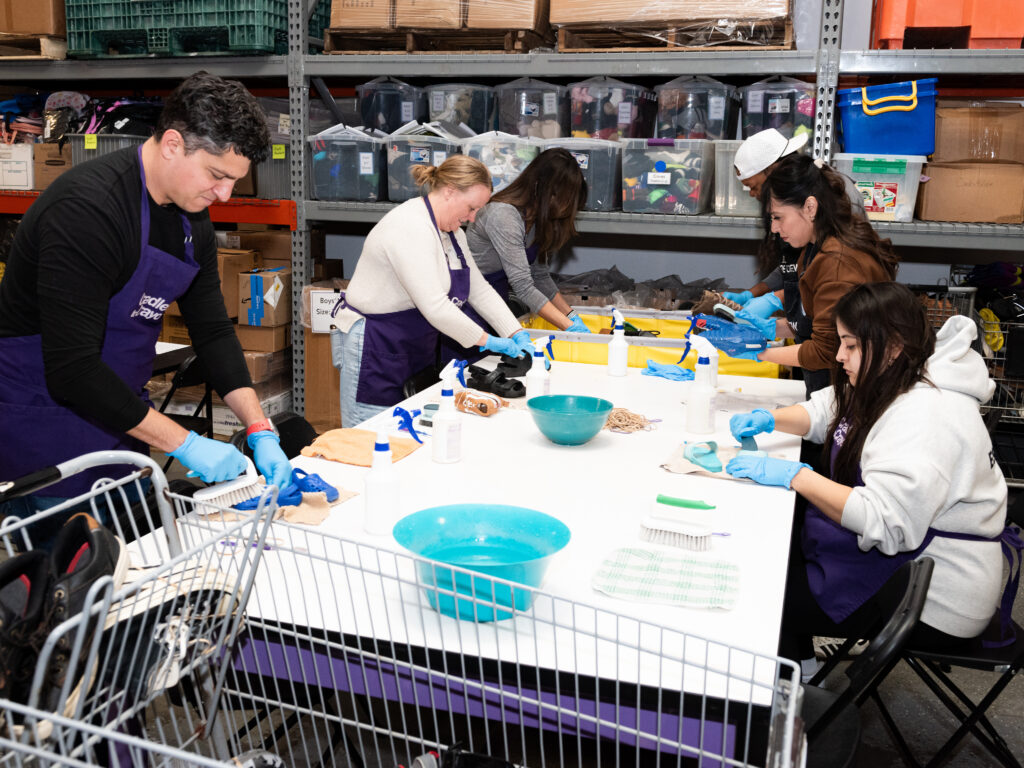
Volunteers clean donated shoes. Photo courtesy of Cradles to Crayons
That doesn’t mean worn, torn, or stained items are simply thrown away. Instead, the organization works with textile recycling partners to give those materials a second life. In Chicago, these go to Chicago Textile Recycling, which largely makes wiping rags for companies.
Textile recyling is an important final step in extending a garment’s life, says Maria Perez, the Recycling Manager at Wipeco, Inc. and Chicago Textile Recycling, because of the 81 pounds of fabric discarded per person annually, 95 percent are recyclable – and this means they can be diverted from landfills and incinerators.
Perez says the company has collected about 284,111 pounds of textiles from Cradles to Crayons, with 95 percent of the items reused and reworn. “This process reduces environmental harm from manufacturing, supports a global economy that provides affordable clothing and repurposes damaged materials into useful industrial products,” Perez says.
The Power of Partnership and Community
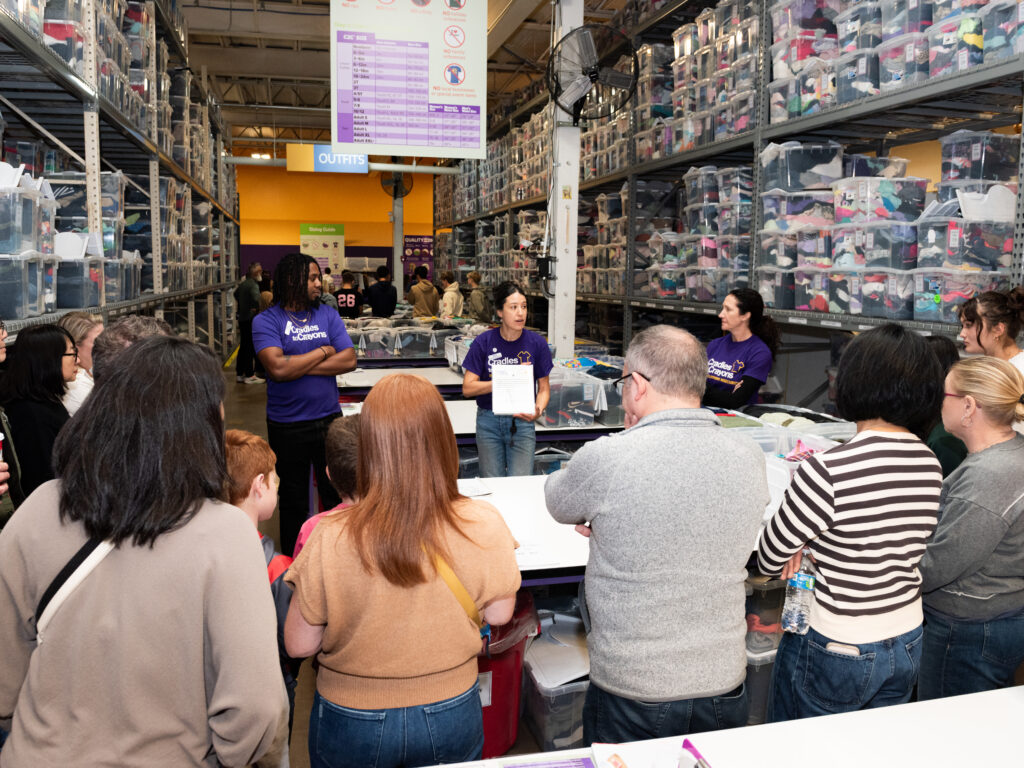
In Chicago, Cradles to Crayons had 19,166 volunteers in the last year for a total of 39,122 volunteer hours. Nelson Warley, Senior Director of Marketing and Communications, says that visiting Chicago’s Giving Factory and seeing people packing clothes and items was heartwarming. “You see action happening throughout the factory, people volunteering,” Warley says.
The Chicago base has been a model in some ways. The Chicago location is where they changed the packing mechanism from black bags to see-through bins, easier to see and stack. They are also trying home pick-up and contemplating something akin to a closet where people can come and choose their own clothes.
Cradles to Crayons works with more than 80 partners in the region, social services big and small. That could include the YMCA as well as a local church pantry or group that serves new parents in one neighborhood. Social workers reach out with needs, and they help facilitate either pickup or delivery.
This year, Cradles to Crayons is celebrating 10 years in Chicago. “There is a lot of need here, but there is so much value that the community brings,” Giordano says. From donating money to donating clothes to donating their time, she says, “We have a lot of people who are willing to do it.”
How to Help
Cradles to Crayons accepts clothing and other essential items, financial donations, and volunteers in the communities they serve, including Chicago, Greater Boston, Greater Philadelphia, New York City, and the San Francisco Bay Area. If there isn’t a location near you, look for local nonprofits that distribute clothing directly to people in need or textile recycling programs that can give worn or damaged items another use instead of sending them to a landfill.
Chicagoans can donate gently used children’s clothing at the Giving Factory in North Center or at any of the designated 40+ drop-off locations. Anyone older than 5 years old is also welcome to volunteer to help sort, inspect, and package donations for distribution. The organization also accepts donations online and items from its Amazon wishlist.
Alison Bowen is an award-winning journalist whose work has appeared in publications like The New York Times, CHICAGO magazine, Cosmopolitan magazine and the Chicago Tribune, where she was a staff reporter and editor for a decade. She is drawn to stories about maternal health, well-being, trauma and resilience.
To provide the best experiences, we use technologies like cookies to store and/or access device information. Consenting to these technologies will allow us to process data such as browsing behavior or unique IDs on this site. Not consenting or withdrawing consent, may adversely affect certain features and functions.
Functional Always active
The technical storage or access is strictly necessary for the legitimate purpose of enabling the use of a specific service explicitly requested by the subscriber or user, or for the sole purpose of carrying out the transmission of a communication over an electronic communications network.
Preferences
The technical storage or access is necessary for the legitimate purpose of storing preferences that are not requested by the subscriber or user.
Statistics
The technical storage or access that is used exclusively for statistical purposes.The technical storage or access that is used exclusively for anonymous statistical purposes. Without a subpoena, voluntary compliance on the part of your Internet Service Provider, or additional records from a third party, information stored or retrieved for this purpose alone cannot usually be used to identify you.
Marketing
The technical storage or access is required to create user profiles to send advertising, or to track the user on a website or across several websites for similar marketing purposes.