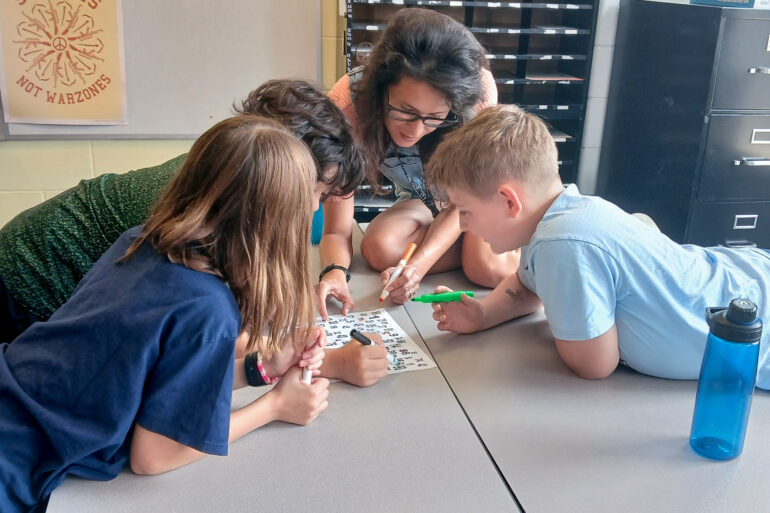
A first-year math teacher stands in her classroom, walls covered in anchor charts that promise mistakes are welcome. She spent her summer building rich, open-ended tasks — the kind she loved in graduate school. On the first day, she learns every student’s name. She is ready.
Then she hands out the math task. Every hand goes up. No one knows where to start. It happens again the next day, and the day after that. Every day, her students are faced with barriers to learning and completing their math lessons.
Students are Facing Barriers to Math Nationwide
This scene happens in classrooms nationwide. Faced with students who can’t get traction, many teachers work to keep students engaged and make math problems easier to understand. They break problems into smaller steps and model procedures, narrowing the path to a single method.
Students might succeed on the next quiz. But mathematics education researchers have long cautioned that this kind of help often comes at a cost, trading genuine mathematical thinking for procedure-following. Jo Boaler’s research archive on student learning notes that struggle and mistakes are linked to brain growth, and that removing struggle too early can quietly remove the learning itself.
On the 2022 National Assessment of Educational Progress, fourth-grade math scores fell five points from 2019, with the steepest declines among students who were already struggling. The National Council of Teachers of Mathematics has made equitable access to genuine mathematical thinking a focus, arguing that access means more than exposure to content. It means the chance to reason, question, and persist. Falling scores and shrinking cognitive demand are not separate stories; a system built around fast, visible correctness leaves little room for students to think for themselves.
Developing the ability to start, to try something wrong, to keep going without being told the next step may be the most overlooked goal in math education. Teachers often describe students as “behind grade level” or lacking fluency in basic facts. But without the confidence to attempt an unfamiliar problem, fluency and pacing become moot. A student who cannot begin cannot get anywhere.
Math Circles Can Bridge the Math Gap
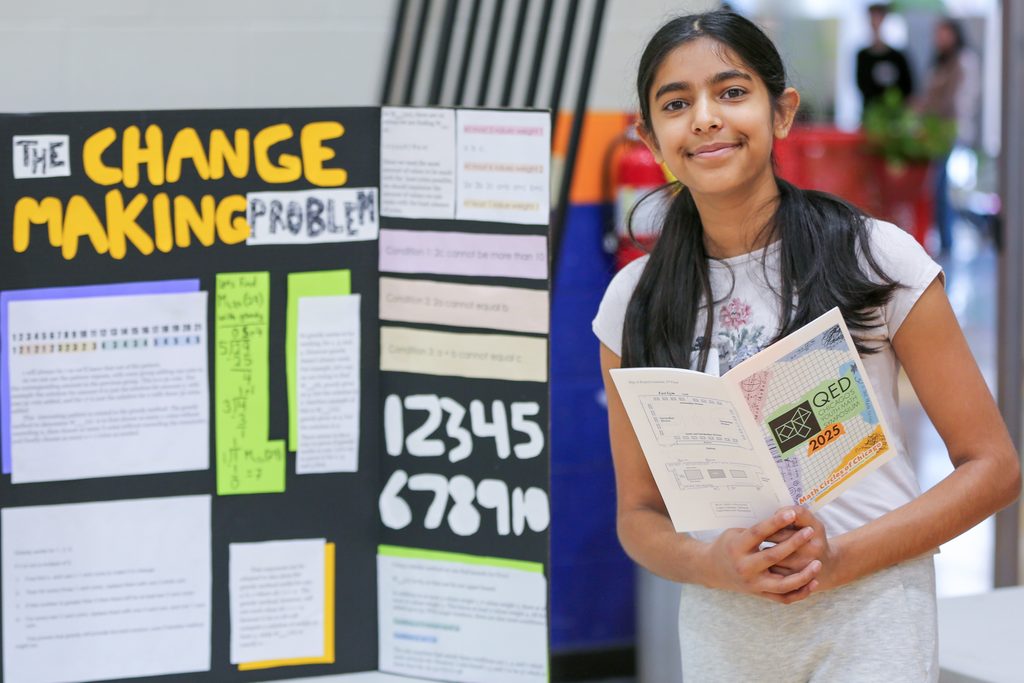
One response gaining traction nationally is the math circle: a space, often free and community-based, where students tackle genuinely hard problems with no grade, no test, and no deadline attached. Math circles operate across the country, cataloged by the American Institute of Mathematics and the National Science Foundation.
The Math Circles of Chicago (MC2), a Make It Better Foundation 2026 Philanthropy Award winner, has served nearly 27,000 students since 2012, two-thirds of them from underserved communities. Nearly 84 percent of MC2 participants say they did math in a way they don’t usually get to in school. Facilitators pose a problem and then step back, letting students argue, guess wrong, and sit with uncertainty longer than any class period allows. Over time, participants shift from asking “Is this right?” to “Tell me if you can follow my thinking.”
The shift from seeking approval to seeking understanding is what access to mathematics actually looks like. Not easier problems, just the chance to think, supported by people who know students have what it takes to succeed.
This post was submitted as part of our “You Said It” program. Each submission serves as the grant application into Better and the Make It Better Foundation’s broader storytelling and funding ecosystem. An excellent “You Said It” can earn a nonprofit you champion a $1,000 grant from the Make It Better Foundation in support of its mission, plus eligibility for an invitation to apply for a Philanthropy Award, expanded content partnerships, and greater engagement with our audience.
How to Help
Math Circles of Chicago is working to make deep, joyful mathematical thinking available to every student, not just those who already see themselves as “math people.” Since 2012, the organization has served nearly 27,000 Chicago students, two-thirds of them from underserved communities, through free after-school programs, weekend hubs open to all students, school-based math festivals, summer camps, an annual math symposium, and college-pathway programs. Readers can support this work by donating to fund a season of math circle programming for a Chicago classroom, volunteering as a circle facilitator or mentor, or judging at our annual math symposium, QED.

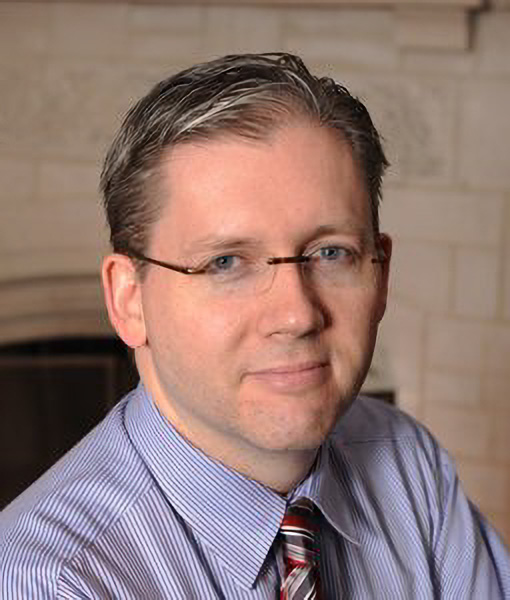
Doug O’Roark is the Executive Director of the Math Circles of Chicago. Previously, he founded and led the secondary math component of the UChicago Urban Teacher Education Program. As a Chicago Public School teacher, he was awarded the Radio Shack National Teacher Award, the MAA’s Sliffe Award for Distinguished Math Teaching, the ICTM Rine Secondary Math Teaching Award, and the Museum of Math’s 2020 Rosenthal Prize for Innovation and Inspiration in Math Teaching. The City of Chicago Math League and Payton High School have awards named in his honor.