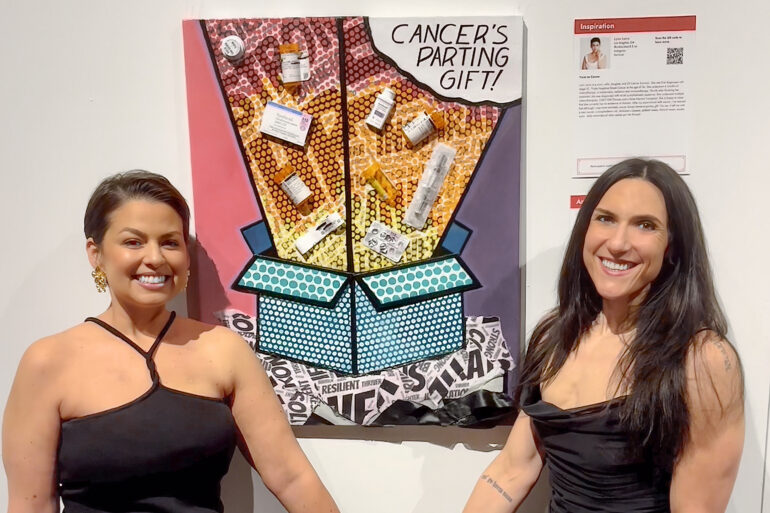
A fellow cancer survivor suggested Lynn Leiro apply to a creative arts program focused on providing support and community to those touched by cancer. She thought it might offer Leiro something different.
It did.
Leiro, 40, is a double cancer survivor whose diagnoses — triple negative breast cancer and acute lymphoblastic leukemia — left her dependent on lifelong medication. When she was introduced to Twist Out Cancer’s Brushes with Cancer program — a six-month cohort pairing inspirations with artists to co-create original works honoring lived experience — she wasn’t looking for transformation. She wanted to connect with others.
That connection started taking shape well before the program’s winter exhibition at WildmanBT in Chicago.
The Emotional Side of Cancer Care
Cancer is primarily treated as a disease of the body. The psychosocial dimensions are addressed less consistently, and often only when they become difficult to ignore.
Yet, many people impacted by cancer report feeling mental and emotional distress. A 2023 American Cancer Society Cancer survey found that 58 to 65 percent of patients and survivors experience social isolation, with nearly one-third reporting frequent loneliness. And studies suggest these experiences extend beyond emotion, affecting how people move through care over time. A 2024 BMJ Oncology meta-analysis linked loneliness with higher risks of both all-cause and cancer-specific mortality.
Research shows isolation often stems from the disease itself — the cancer-related fears, the stigma of treatment effects, the loss of identity after care. Survivorship, then, is not a medical outcome but a new reality shaped by what is not always visible.
What many need is a space where none of that has to be explained.
Healing Through Creative Expression
A growing body of evidence points to creative expression as a way survivors process cancer and life after.
Reviews in the Journal of Cancer Survivorship and Supportive Care in Cancer suggest visual art and music-based interventions can reduce anxiety and depression, as well as improve quality of life, self-image, and emotional expression. What’s more, European Journal of Cancer Care research found that younger survivors like Leiro often describe creative expression as a way of being seen, while an Occupational Therapy International study shows it can help make sense of identity after illness.
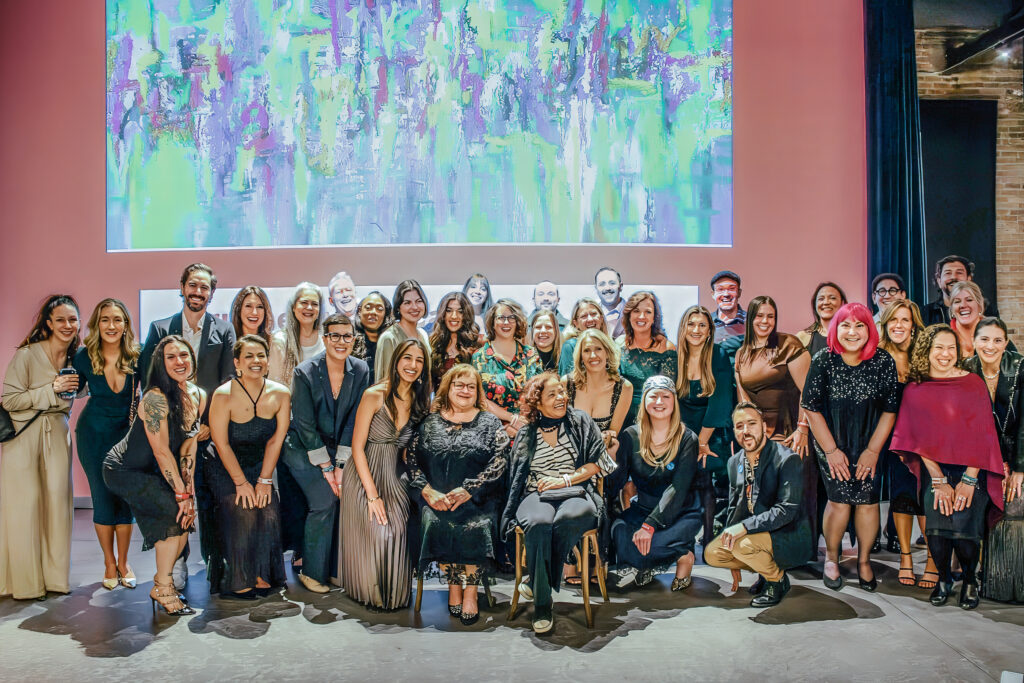
Creative expression gives form to experiences otherwise difficult to articulate. Nonprofits like Twist Out Cancer build on this idea by bringing together survivors and artists in long-term collaboration.
For Leiro, the emotional impact unfolded over conversations and shared reflection. “Hearing everyone’s stories through art was super impactful in a way that surprised me,” she says. And she found a sense of recognition in that process. “There is an overarching understanding of what we went through.”
What Connection Looks Like After Treatment
For months, Leiro followed her artist’s progress through images. But standing in front of the finished work changed its scale. “Seeing the painting in person was so exciting,” Leiro says. “Seeing all the dimensions, textures, and mixed media was something I’d never seen before.”
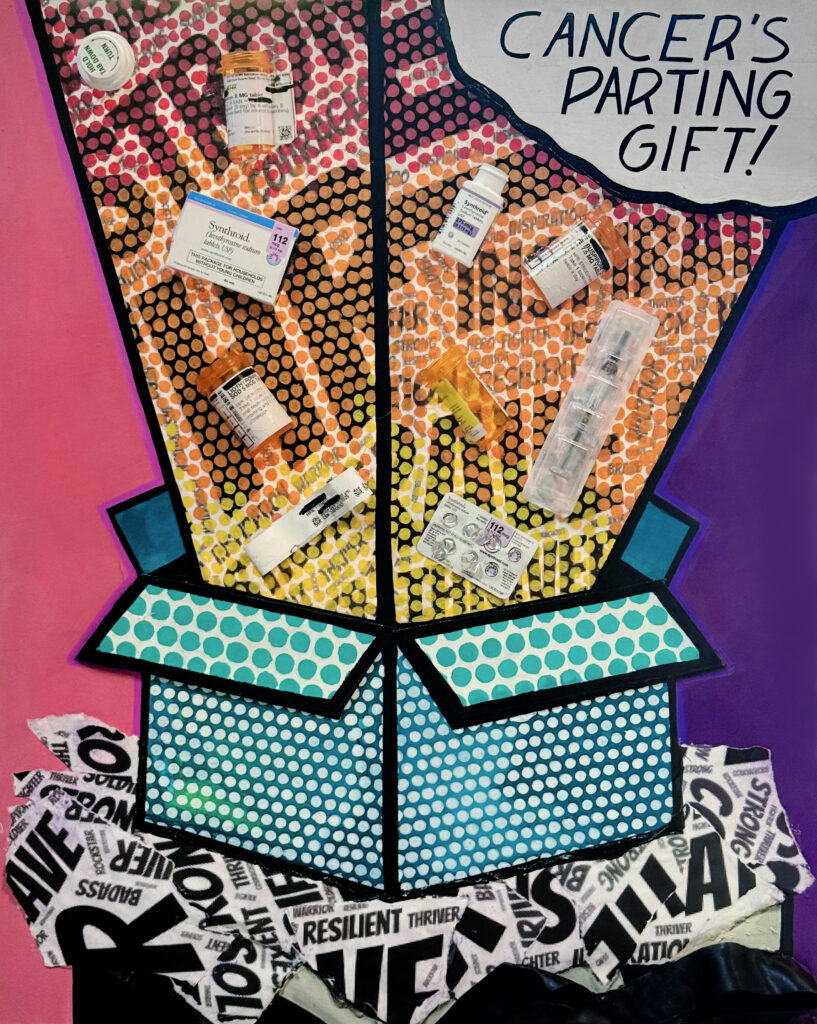
The painting, “Cancer’s Parting Gift,” was created by Annamaria Scaccia, also a double cancer survivor — kidney and thyroid. The concept came from one of Leiro’s early reflections — because of cancer, she now needs daily medication. It’s something Scaccia also lives with.
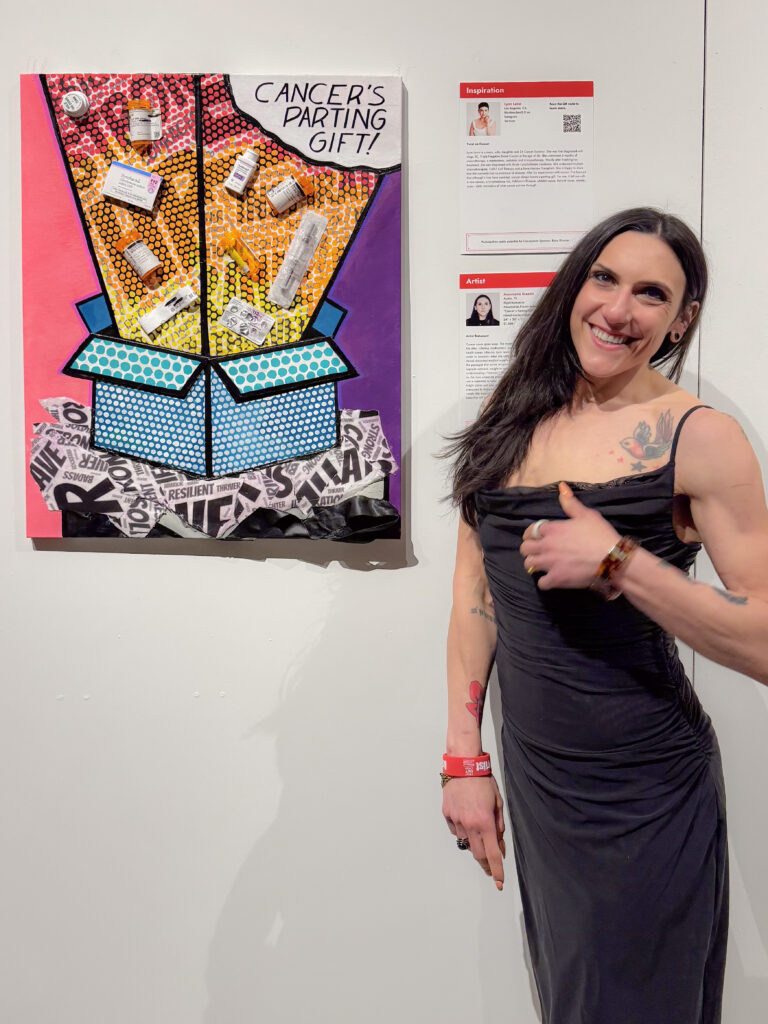
“The painting captured a true shared experience that most survivors can relate to,” Leiro says.
The idea of “art as witness” runs through the research. But for Leiro, it returns to something simpler. “Community is the most important part of a survivor’s success post-treatment,” she says. “BWC connects everyone in a way where we are all healing together.”
Thanks to advances in detection and treatment, there are now more than 53 million cancer survivors worldwide. This number continues to grow. What remains less resolved is how identity and meaning are rebuilt through and beyond treatment.
Creative expression is part of the answer. Not a supplement to care, but a form of it.
How to Help
There are many ways to support Twist Out Cancer. You can donate to fuel programs that reach hundreds of participants each year, volunteer as an artist or event ambassador in cities across the country, attend a Brushes with Cancer event, become a sponsor or healthcare collaborator, or simply learn more at twistoutcancer.org.

This post was submitted as part of our “You Said It” program.” Your voice, ideas, and engagement are important to help us accomplish our mission. We encourage you to share your ideas and efforts to make the world a better place by submitting a “You Said It,” which can earn a nonprofit that you champion a $1,000 donation from the Make It Better Foundation and eligibility for a Philanthropy Award, grant content partnership, and greater engagement with our audience.
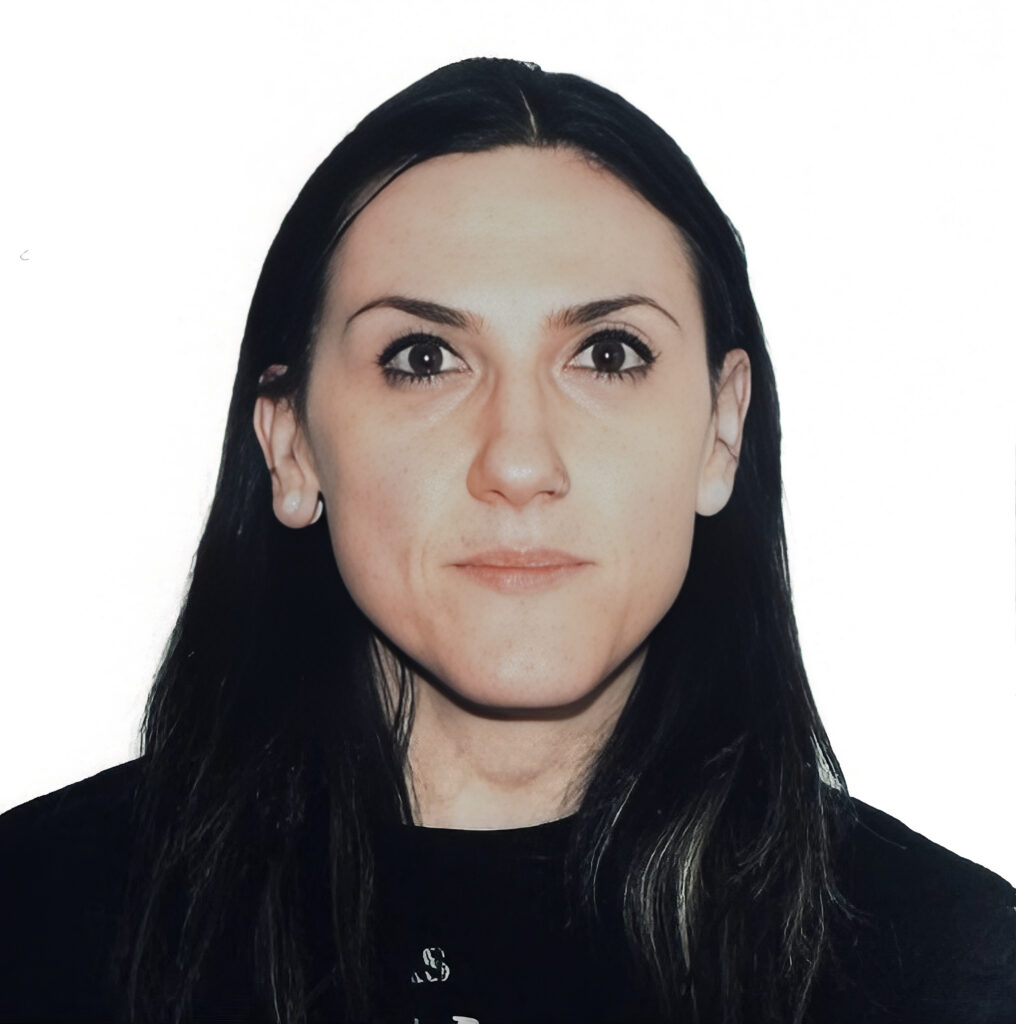
Annamaria Scaccia is an artist, poet, and award-winning journalist who has survived both kidney cancer and thyroid cancer by 40. She uses her experiences to support and empower patients and survivors through creative expression, peer-to-peer advocacy, research and legislative advocacy, adaptive fitness and nutrition, educational content, and community building. Outside of advocacy, she’s a competitive one-kidney bodybuilder, a coffee snob, and someone who would never turn down a good loaf of bread. Originally from Brooklyn, Annamaria now lives in Austin with her son, her partner, and their two dogs and two cats.
More from Better
- From Diagnosis to Canvas: How Brushes With Cancer Uses Art to Bring Strength and Healing to Cancer Journeys
- Twist Out Cancer Expands Programming Accessibility to Reach More Individuals Touched By Cancer
- Are Kids Losing Creativity? How America’s Arts Education Crisis Could Affect Innovation, Mental Health, and the Future Workforce
- Pediatric Cancer Research Gets Less Than 4% of Federal Funding — Leaving Children With Decades-Old Treatments