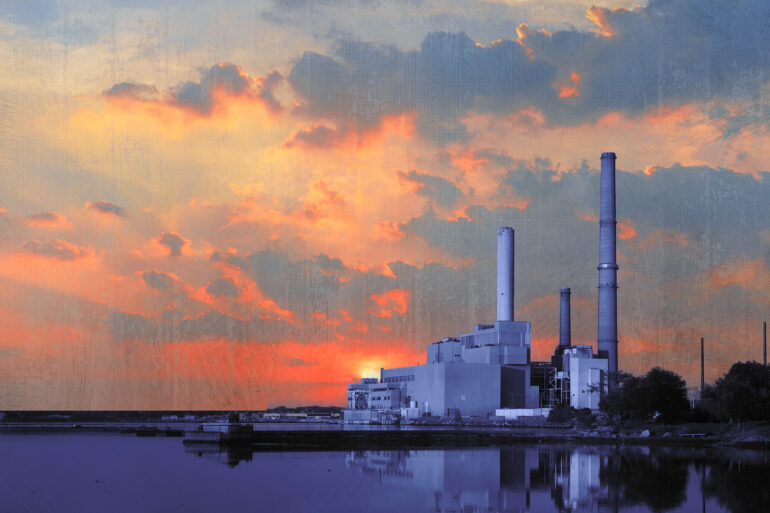
Friends would gather to watch the unusually vibrant shades of orange, magenta, and purple paint the skies over my mother’s childhood home in Manchester-by-the-Sea each evening. No one realized the otherworldly sunsets came from pollution streaming out of the smokestacks six miles across Salem Sound. Nor that they represented ominous harbingers of a tragic family history that I share today in a plea to our incoming Congress to make reversing regressive coal policy a priority.
Salem Harbor Power Plant was the oldest of Massachusetts’ “Filthy Five” coal plants. Grandfathered in against regulation, it was allowed to contaminate the air my mother’s family breathed and the waters they fished for decades.
Their home of Essex County became one of the country’s most polluted, ranking in the top 10 percent of emissions in air toxics like nitrogen oxides, sulfur dioxide, and PM2.5. Meanwhile, the plant dumped coal ash waste — containing arsenic, radium, and other heavy metals linked to cancer and neurological damage — into unlined storage lagoons that allowed it to leach into the Sound.
By the time then-Governor Mitt Romney stood at Salem’s gates and famously declared “that plant kills people,” in March of 2003, my mother’s family were already victims of the area’s higher rates of respiratory illness and premature death reported by Harvard’s School of Public Health.
Three years earlier, my then-middle-aged grandmother had died from aggressive stomach cancer, perplexing doctors. Not only did she, like my grandfather, have parents and siblings alive and well, but the illness usually afflicted older men.
Months after the Governor spoke, her widowed husband would die of a rare brain tumor. My mother, hospitalized with pneumonia and asthma as a child, luckily caught her own cancer early enough to avoid her parents’ fate.
I never met my grandparents. I honored their memory by interning at Boston’s Conservation Law Foundation (CLF), the environmental advocacy organization whose tireless work finally shuttered Salem in 2014 and secured its transition to clean energy. CLF’s victory was part of a nationwide trend away from our dirtiest fossil fuel toward cleaner alternatives. Coal’s share of electricity generation plummeted from 52 percent in 1990 to 17 percent last year, with 330 plant closures by 2010 and 60 more scheduled by 2031.
Today, however, this hard-earned progress is in danger. Under the call for “clean, beautiful coal,” our administration has co-opted $700,000,000 to fund the nation’s first new plants since 2013 and enable more than a dozen more to stay open, including those with repeated pollution violations.
Tennessee’s Cumberland Plant is one example. Party to a 2011 lawsuit over Clean Air Act non-compliance, with further citations in 2017 and 2023, it was due to close by 2028. Once the administration replaced operator board members and pledged $46 million, the planned shutdown was scrapped.
Key coal pollution protections have also been gutted. In the summer of 2026, EPA head Lee Zeldin told industry leaders at the National Coal Council, “many of the items that were on your wish list are now done,” promising more to come. From ending carbon limits on fossil-fired plants and consideration of ‘lives saved’ in emissions regulation to rolling back oversight of Mercury and Air Toxics Standards and coal ash disposal, he’s delivered. In Alabama, for example, the administration is moving to allow millions of tons of toxic coal ash to be buried alongside state rivers – and its countless pollutants to leach out through groundwater. These are the rivers families swim and fish in, just like my mother’s did in Salem Sound.
While incoming members of Congress may not always see eye to eye, shielding Americans from coal’s dangers can be a unifying issue. Indeed, it should be bipartisan. Mitt Romney, who warned the public of Salem’s dangers, is a Republican. Moreover, it was 200 MAHA activists who penned an open letter to the president in August 2026, imploring change. “When coal burns,” they wrote, “the pollution has to go somewhere. It goes into the air, water, soil, fish, and ultimately into the bodies of American families.”
Mine is one of those families. Before more Americans face higher rates of illness and premature death, I urge the new Congress to cap funding for Department of Energy subsidies for coal plant extensions and increase legislative oversight over EPA regulatory decisions.
“Clean, beautiful coal” is as much of an illusion as the splendor of those poisoned sunsets. Sitting on their patio in Manchester, watching them illuminate the evening sky, my grandparents didn’t realize the truth until it was too late. Our leaders have no such excuse.
This post was submitted as part of our “You Said It” program. We encourage you to share your ideas and efforts to make the world a better place by submitting a “You Said It,” which can serve as the application for a $1,000 grant award from the Make It Better Foundation for a nonprofit you champion and eligibility for a Philanthropy Award, grant content partnership, and greater engagement with our audience.
How to Help
Contact your representatives: Ask your members of Congress to cap Department of Energy subsidies that keep aging coal plants open and to strengthen oversight of EPA rollbacks on coal pollution. Find your representative at house.gov and your senators at senate.gov.
Support the work: The Conservation Law Foundation led the fight that closed Salem Harbor Power Plant and continues to fight coal pollution across New England. Donate to support their ongoing work.
Caleb Yellin is a senior at the Windward School.